
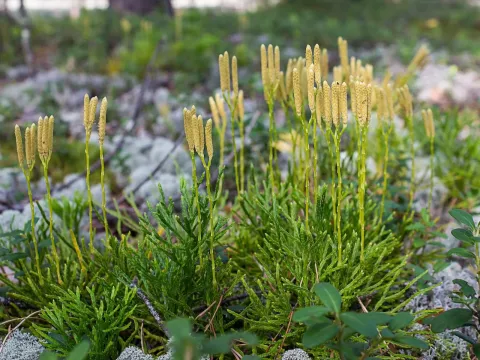
Stag's-horn clubmoss
Lepidotis
Lycopodium clavatum, the stag's-horn clubmoss, is a perennial evergreen plant belonging to the Lycopodiaceae family. It is characterized by long, creeping stems that sprawl across the forest floor.
What the section contains
Stag's-horn clubmoss
This species is found primarily in coniferous forests, where it thrives in moist, acidic soil conditions. It requires specific mycorrhizal fungi in the soil to germinate its spores.
The plant is highly dependent on a stable microclimate with high air humidity and protection from direct, harsh sunlight, favoring partially shaded areas instead.
Biological development is exceptionally slow. It can take several years for the plant to mature enough to produce strobili (spore-bearing cones), making it a fragile component of forest ecosystems.
Due to its slow growth rate and sensitivity to environmental changes, stag's-horn clubmoss is often legally protected and not suitable for conventional intensive agricultural cultivation.
The economic value of Lycopodium clavatum lies mainly in its spores, historically known as lycopodium powder. Yield is dependent on the density of wild populations.
In the pharmaceutical industry, the spores serve as a natural alternative to talc for baby powders and as a non-stick coating for medical pills and tablets.
Metal casting is another traditional sector where the powder is used to coat sand molds, ensuring a clean finish on precision metal parts.
The pyrotechnic industry utilizes the flammable nature of the spores to create quick-burning effects, a unique property that stems from the high oil content within the spores.
While demand exists, the harvest is strictly managed to ensure the long-term survival of the species in its natural habitat.
The primary threats to stag's-horn clubmoss include large-scale deforestation, soil compaction, and pollution of forest soils, which disrupt the symbiotic fungi it relies on.
Human activity, such as heavy pedestrian traffic in forests, easily damages the delicate trailing stems, leading to the fragmentation of its colonies.
Over-harvesting of the cones by untrained collectors remains a critical threat, as improper collection methods often result in the death of the parent plant.
Climate change, specifically prolonged droughts, threatens to destroy the specific humidity levels required for the successful development of the prothallium.
Conservation strategies focus on designating protected areas and educating the public on sustainable harvesting practices to prevent local extinction.
Harvesting of the strobili occurs during mid-to-late summer when the cones turn a distinct yellowish hue, indicating that the spores are fully mature.
Cones are carefully clipped to avoid damaging the main stem system, which is essential for the continued life of the plant colony.
After clipping, the cones are transported in moisture-resistant containers and allowed to dry in a controlled environment to release the spores.
The dried spores are then sifted through fine meshes to remove plant debris, resulting in a fine, golden-yellow powder that feels slick to the touch.
Proper storage is crucial, as the spores are hygroscopic; they must be kept in airtight containers to maintain their performance in industrial or medicinal applications.