
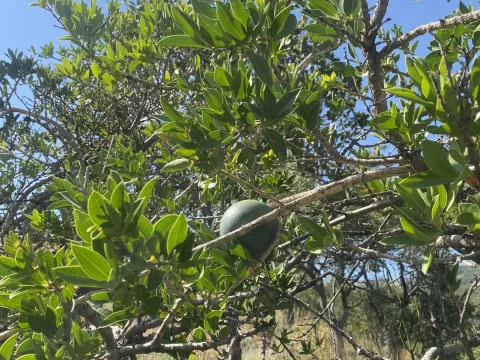
Strychnos pungens
Strychnos pungens
Strychnos pungens is a resilient shrub or small tree belonging to the Loganiaceae family, native to the savanna regions of Southern Africa. It is well-adapted to surviving in harsh environments with prolonged dry seasons and nutrient-poor soils.
What the section contains
Strychnos pungens
The plant thrives in well-drained sandy or rocky substrates. It requires full sunlight exposure to maintain its structural integrity and physiological health, making it unsuitable for shade-grown agroforestry systems.
Climatic requirements focus on high heat tolerance and the ability to withstand significant temperature fluctuations between day and night. While the plant is drought-resistant, young specimens benefit from occasional irrigation during their establishment phase.
Botanically, the plant is characterized by its stiff, pointed, opposite leaves and dense, corky bark. These adaptations are essential for minimizing water loss and protecting the inner tissues from excessive solar radiation in an open savanna biome.
In terms of propagation, seeds should be sown in loose, well-draining soil mixtures. Maintenance involves pruning dead wood to encourage canopy development and ensuring proper spacing between plants to prevent competition for limited soil resources.
The fruit of Strychnos pungens is a large, hard-shelled berry that changes from green to a yellowish or brown color upon ripening. Harvesting is typically timed with the peak of the ripening season to ensure the fruit has developed its full sugar content.
Due to the protective, woody nature of the fruit shell, manual harvesting is the only viable method. The fruit requires significant physical force to open, after which the edible pulp can be extracted for fresh consumption or local processing.