
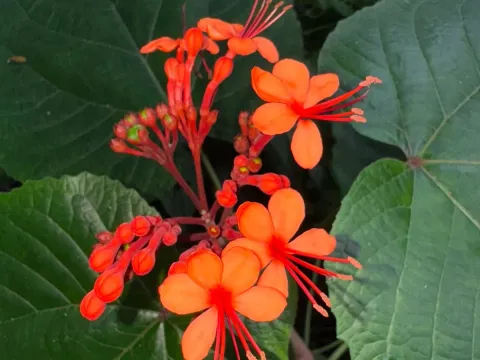
Clerodendrum
Clerodendrum
Clerodendrum is a diverse genus of flowering plants belonging to the Lamiaceae family. Native to tropical and subtropical regions of Africa, Asia, and the Americas, these plants exist primarily as shrubs, woody climbers, or small trees, prized for their exotic floral displays.
What the section contains
 Bleeding heart vine
Clerodendrum thomsoniae Balf.
Bleeding heart vine
Clerodendrum thomsoniae Balf.
 Clerodendrum laevifolium
 Blume
Clerodendrum laevifolium
Clerodendrum laevifolium Blume
 Clerodendrum paniculatum
 L.
Clerodendrum paniculatum
Clerodendrum paniculatum L.
 Clerodendrum quadriloculare
Clerodendrum quadriloculare
Clerodendrum quadriloculare
 Harlequin glorybower
Clerodendrum trichotomum Thunb.
Harlequin glorybower
Clerodendrum trichotomum Thunb.
 Japanese glorybower
Clerodendrum japonicum (Thunb.) Sweet
Japanese glorybower
Clerodendrum japonicum (Thunb.) Sweet
 Rose Glorybower
Clerodendrum bungei Steud.
Rose Glorybower
Clerodendrum bungei Steud.
Clerodendrum
The botanical structure of Clerodendrum is notable for its distinct calyx and corolla tubes, often accompanied by long, prominent stamens. The leaves are typically opposite, sometimes whorled, and can range from ovate to cordate shapes, providing a lush green foliage aesthetic.
Cultivation requires a location with bright, filtered sunlight to ensure optimal growth and flower induction. Exposure to direct intense sunlight can scorch the foliage, while insufficient light leads to elongated, spindly shoots and poor blooming performance.
A well-draining, nutrient-rich soil mix is crucial for the healthy development of the root system. A base of peat-based potting soil amended with perlite or coarse sand provides the necessary aeration and moisture-retention balance required for the genus.
Agronomic management involves regular pruning to maintain the plant's shape and encourage a more compact growth habit. Many species respond well to hard pruning after the flowering season, which rejuvenates the plant and supports vigorous new growth the following cycle.
The primary pests affecting Clerodendrum are spider mites and whiteflies, especially in environments with low relative humidity. Effective management includes regular misting, maintaining proper air circulation, and the application of horticultural oils or soap sprays.
Mealybugs can often be found hiding in the leaf axils, sucking the sap and causing stunted growth. Manual removal with an alcohol-soaked swab followed by systemic insecticide application is standard practice for controlling localized infestations.
Fungal leaf spot diseases may appear during periods of high humidity and poor ventilation. Providing adequate spacing between plants and avoiding overhead irrigation helps to mitigate the risk of pathogen transmission and spore germination.
Root rot is a common physiological disorder resulting from overwatering or inadequate soil drainage. It is essential to ensure the pots have proper drainage holes and that the growing medium is allowed to dry slightly between watering cycles.
Chlorosis, manifesting as yellowing between leaf veins, is frequently observed due to a pH imbalance or iron deficiency. Adjusting the water quality and utilizing iron chelates in the fertilization program will restore the plant's healthy green pigmentation.