
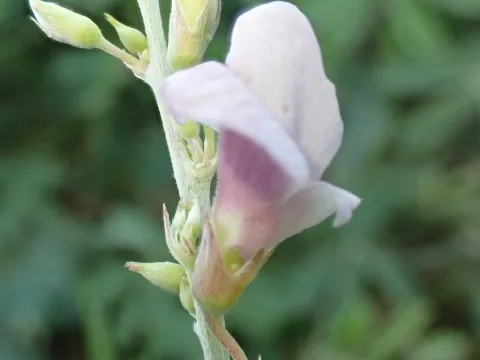
Tephrosia cinerea
Tephrosia cinerea
Tephrosia cinerea is a tropical legume widely valued for its role in sustainable agriculture and soil health restoration. Sowing typically takes place at the beginning of the rainy season, ensuring the seeds receive the moisture necessary for successful germination and initial establishment.
What the section contains
Tephrosia cinerea
The seeds possess a hard seed coat, making scarification a recommended practice to improve uniformity of emergence. Once the hard coat is breached, the plant exhibits rapid growth, quickly establishing a canopy that effectively suppresses weed growth.
When used as a green manure, seeds are often broadcasted to create a dense stand. The plant does not require intricate soil preparation, although deep tillage can enhance the development of its characteristic deep taproot system.
Adequate soil moisture is critical during the first few weeks post-emergence. Despite the mature plant's high drought tolerance, the young seedlings are vulnerable to extreme moisture deficits until the root system has sufficiently penetrated deeper soil horizons.
Incorporating symbiotic nitrogen-fixing bacteria via seed inoculation is a highly beneficial practice, particularly on degraded or nutrient-poor soils where native rhizobia populations may be insufficient.
This crop thrives in well-drained sandy or loamy soils, showing remarkable resilience to poor fertility. It is an excellent pioneer species for land rehabilitation, capable of establishing itself in environments where other crops struggle.
Tephrosia cinerea is a heliophilous species, requiring full sun exposure to achieve its growth potential. Shading from larger canopy crops or trees significantly limits biomass production and compromises the plant's structural integrity.
Temperature requirements are consistent with tropical climates, with optimal development occurring between 25°C and 35°C. The species is highly sensitive to frost and is strictly confined to frost-free tropical and subtropical zones.
The plant demonstrates extreme drought tolerance, largely attributed to its deep, vigorous taproot. This feature allows it to survive extended dry spells, effectively maintaining soil cover even under adverse environmental conditions.
While relatively indifferent to soil pH, the plant shows the best performance in neutral to slightly acidic soils. Good soil aeration is essential for the effective function of root nodules and overall plant vigor.
The yield of Tephrosia cinerea is measured in terms of total biomass production, which serves as high-quality organic matter. When properly managed, the crop generates significant vegetative cover that substantially improves soil physical properties.
Beyond biomass, the plant contains secondary metabolites like rotenoids, which provide insecticidal properties. This dual-purpose utility adds value to the crop, as it serves as both a soil improver and a biological defense agent in agroecosystems.
To maximize nitrogen contribution, the crop should be harvested or incorporated before full flowering, as the nitrogen content in the tissues is highest during the vegetative stage and early bud development.
Seed production yields are dependent on favorable climatic conditions and effective pollination. Consistent moisture during the reproductive phase helps maximize the number of pods formed per plant.
The long-term impact on soil fertility is a hallmark of this crop, leading to increased microbial activity and improved nutrient cycling, which cumulatively enhances the yield potential of subsequent economic crops.
Tephrosia cinerea possesses a high degree of natural resistance to most agricultural pests, largely due to the presence of deterrent chemical compounds in its leaves and stems. This inherent resilience simplifies its cultivation.
The main threats to the crop are largely associated with poor management practices. Excessive soil moisture or stagnant water can lead to root rot diseases, while high density in humid conditions may promote fungal foliage pathogens.
- Root rot (due to poor drainage)
- Powdery mildew (in poor air circulation conditions)
- Root-knot nematodes (rarely problematic unless in continuous monoculture)
Preventative strategies focus on crop rotation and ensuring optimal soil drainage. Avoiding over-irrigation is the most effective measure against subterranean diseases that can impact the taproot.
Field scouting for any signs of leaf discoloration or wilting should be conducted, although, in most agricultural scenarios, Tephrosia cinerea requires minimal intervention and no synthetic pesticide application.
Green manure harvesting is conducted by cutting the above-ground biomass at the early flowering stage. This timing optimizes the carbon-to-nitrogen ratio, facilitating rapid decomposition once the material is incorporated into the soil.
Incorporation is typically performed using discs or plows, which integrate the biomass into the top 10-15 cm of soil. This process builds organic matter and makes nitrogen available for the subsequent main crop cycle.
For seed collection, the harvest takes place once the pods have fully matured and turned brown. The pods should be harvested promptly to prevent spontaneous shattering and seed loss in the field.
In conservation tillage systems, the crop may be left as a mulch layer on the soil surface. This layer effectively reduces soil temperature fluctuations and protects the ground from rainfall impact, preventing erosion.
Post-harvest handling of seeds includes thorough drying and cleaning to remove debris. Storing seeds in a cool, dry place ensures the longevity of their viability for future planting seasons.