
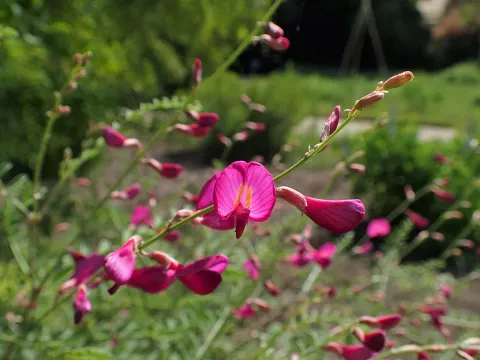
Hedysarum multijugum
Hedysarum multijugum
Sowing of Hedysarum multijugum is recommended in the spring period as soon as the soil warms up to 8-10 degrees Celsius. It is crucial to ensure sufficient soil moisture during the first weeks after sowing to promote uniform germination.
What the section contains
Hedysarum multijugum
The sowing depth typically varies from 2 to 3 centimeters depending on the mechanical composition of the soil. Excessive depth can lead to delayed germination due to the slow warming of lower soil layers.
The seeding rate is calculated based on the purity and germination capacity of the seeds, averaging 12–15 kg per hectare. When using row seeding, the row spacing should be approximately 15 centimeters.
To improve germination, the seeds of the crop undergo mandatory scarification, which promotes the quick emergence of hard-coated seeds. This procedure significantly increases field emergence and plant density.
Hedysarum multijugum is characterized by a slow initial growth rate in its first year, making it essential to ensure the field is free of weeds. It is recommended to use selective herbicides or perform regular inter-row cultivation.
Hedysarum multijugum belongs to the Fabaceae family and is a perennial herbaceous plant with high drought resistance. The crop is adapted to harsh climatic conditions and is capable of withstanding significant temperature fluctuations.
The plant prefers well-drained chestnut or chernozem soils with a neutral or slightly alkaline reaction. Saline and waterlogged areas are absolutely unsuitable for effective cultivation.
One of the key features is a powerful root system that penetrates to significant depths, allowing the crop to extract moisture from lower soil horizons. This makes it a valuable plant for regions with insufficient rainfall.
For optimal development, Hedysarum requires an open, sunny location, as the plant is extremely light-demanding and does not tolerate shading. Intensive lighting contributes to the accumulation of nutrients in the above-ground biomass.
In its natural habitat, the plant grows on rocky slopes and steppes. In agricultural settings, it requires minimal application of phosphorus-potassium fertilizers, which stimulate root development and increase winter hardiness.
The productivity of Hedysarum multijugum is considered high provided that the agrotechnological cycle is correctly followed. Maximum green mass indicators are reached in the second to third year of the plant's life.
Hay yield under favorable weather conditions ranges from 3 to 5 tons per hectare for a single full cutting. The crop is valued for its high protein content and excellent palatability for all types of livestock.
In addition to green mass, Hedysarum is a source of seeds, with yields of approximately 300-500 kg per hectare. Stable fruiting is maintained for 5-7 years if cutting is performed on time.
Agricultural use of the crop includes the establishment of long-term pastures and the harvesting of high-quality haylage. The legume component significantly enriches the animal diet with minerals and vitamins.
The plant possesses nitrogen-fixing properties, which help improve soil fertility and accumulate biological nitrogen. After plowing a field occupied by Hedysarum, the soil becomes enriched with organic matter, benefiting subsequent crops in the rotation.
The main diseases of Hedysarum include fungal infections such as powdery mildew and anthracnose, which are particularly evident in years with high humidity during the vegetation period.
Pests of the crop are mainly represented by weevils and aphids, which can damage reproductive organs and young shoots. Systematic monitoring of the fields allows for the timely localization of infection hotspots.
To protect the crops, it is recommended to apply an integrated approach combining crop rotation and treatment with fungicides or insecticides during critical growth stages.
Weeds are a serious competitor in the initial stages of development, so agronomists must monitor the fields until the Hedysarum canopy closes.
Improper grazing regimes or overly frequent cutting can lead to thinning of the stands and loss of productive longevity. It is important to maintain a balance between exploitation and periods of stand recovery.
The optimal time for cutting for hay is the stage of full flowering or the beginning of seed pod formation. During this period, the plant is maximally saturated with nutrients and protein.
When harvesting, it is important to consider the cutting height, which should be at least 5-7 centimeters to ensure rapid regrowth of the aftermath. Cutting too low can lead to damage of the root crown.
Hay drying is performed directly in the field using tedding for uniform wilting. It is important to avoid over-drying to preserve the foliage and nutritional value of the product.
For seed production, harvesting is carried out when the majority of the pods turn dark to prevent premature cracking and shattering of the seeds onto the ground.
Post-harvest seed processing includes thorough cleaning from impurities and drying to the standard moisture content. Quality seed ensures high productivity of future stands.