
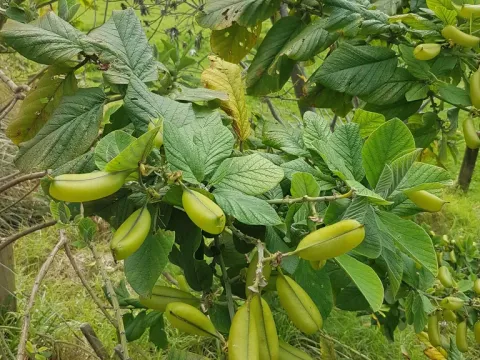
Crotalaria
Crotalaria
Crotalaria is a thermophilic crop, so sowing timing is strictly dependent on soil temperature. The optimal period begins when the topsoil warms up to +15...+18 degrees Celsius.
What the section contains
 Crotalaria brevidens
 Benth.
Crotalaria brevidens
Crotalaria brevidens Benth.
 Crotalaria breviflora
 DC.
Crotalaria breviflora
Crotalaria breviflora DC.
 Crotalaria grahamiana
 Wight & Arn.
Crotalaria intermedia
Crotalaria brevidens Benth. var. intermedia (Kotschy) Polhill
Crotalaria grahamiana
Crotalaria grahamiana Wight & Arn.
Crotalaria intermedia
Crotalaria brevidens Benth. var. intermedia (Kotschy) Polhill
 Crotalaria lanceolata
 E. Mey.
Crotalaria lanceolata
Crotalaria lanceolata E. Mey.
 Crotalaria medicaginea
 Lam.
Crotalaria medicaginea
Crotalaria medicaginea Lam.
 Crotalaria micans
 Link
Crotalaria micans
Crotalaria micans Link
 Crotalaria ochroleuca
 G. Don
Crotalaria paulina
Crotalaria paulina Schrank
Crotalaria ochroleuca
Crotalaria ochroleuca G. Don
Crotalaria paulina
Crotalaria paulina Schrank
 Showy crotalaria
Crotalaria spectabilis Roth
Showy crotalaria
Crotalaria spectabilis Roth
 Smooth rattlebox
Crotalaria pallida Aiton
Smooth rattlebox
Crotalaria pallida Aiton
 Sunn hemp
Crotalaria juncea L.
Sunn hemp
Crotalaria juncea L.
Crotalaria
In temperate climates, seeding is conducted in late spring once the danger of night frosts, which are lethal to young seedlings, has passed.
To produce high-quality biomass, seeds are planted using row or wide-row spacing. The seeding rate varies from 20 to 50 kg per hectare, depending on whether the goal is green manure or seed production.
An important aspect is the seeding depth, which should not exceed 2–3 centimeters. If planted too deep, small seeds may fail to emerge as they deplete their energy reserves before reaching the surface.
After sowing, it is recommended to roll the soil to improve seed-to-soil contact and ensure uniform germination, which is especially critical in moisture-deficient conditions.
Belonging to the Fabaceae family, this crop is valued as an effective soil-improving plant. It prefers well-drained sandy loam or loamy soils with a neutral or slightly acidic pH.
Crotalaria possesses a unique ability to fix atmospheric nitrogen through symbiosis with nodule bacteria. This allows the plant to thrive even on soil plots with low nutrient content.
The plant is drought-tolerant; however, for maximum vegetative mass formation, sufficient rainfall during the active growing period is required.
It is extremely sensitive to waterlogging, making plots with high groundwater levels unsuitable. In such conditions, the root system is quickly affected by rot, leading to crop failure.
For successful cultivation, adequate light must be provided, as Crotalaria does not tolerate competition from weeds during the early stages of its development.
The biomass yield of Crotalaria depends directly on the quality of agronomic practices and climatic conditions. With proper care, results can reach 20–40 tons of green mass per hectare.
The nitrogen accumulation in the soil after incorporating this crop into the ground is comparable to applying significant doses of mineral fertilizers, making it an essential tool in organic farming.
When grown for seeds, yields typically range from 0.5 to 1.5 tons per hectare. It is important to note that the maturation of the pods is often uneven across the plant.
Economic use of the crop includes fiber production from the stems, which is comparable in strength to jute or hemp, as well as its use as a livestock feed supplement.
It should be noted that some species contain alkaloids, so verification of the specific variety and toxicological testing are required before using it as animal feed.
The main threats to Crotalaria are fungal diseases that develop under high humidity and poor ventilation. These include root rot and various leaf spot diseases.
Among pests, various species of weevils and the legume pod borer pose the greatest danger, as they are capable of destroying a significant portion of the plant's reproductive organs.
Crops may also suffer from aphid infestations, which not only sap plant vitality but also act as vectors for viral infections that reduce growth vigor and seed quality.
For large-scale pest control, integrated protection systems are employed, including the use of biological agents and timely fumigation of seeds before planting.
Disease prevention relies primarily on crop rotation. It is not recommended to return Crotalaria to the same field more than once every 3–4 years to prevent the buildup of soil-borne pathogens.