
Showy crotalaria
Crotalaria spectabilis Roth
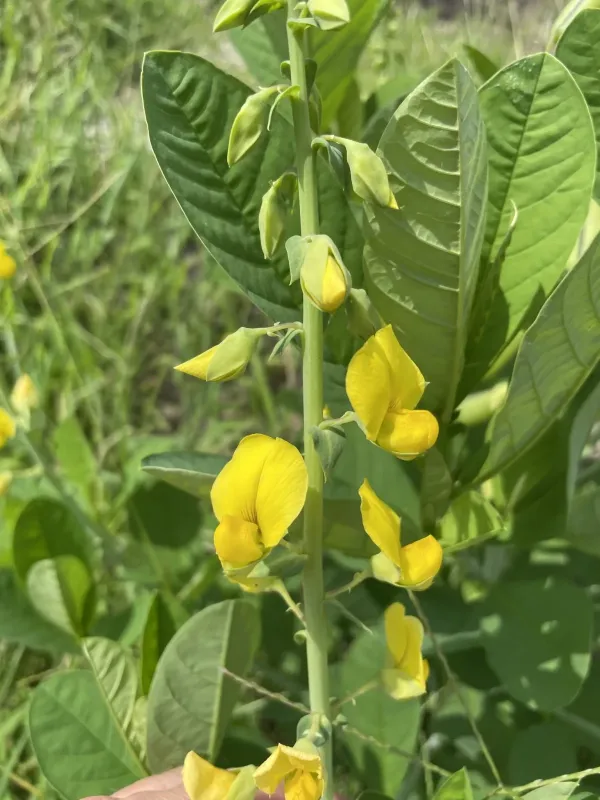
Description
Sowing dates
Showy crotalaria is a warm-season legume that requires high temperatures for optimal germination and development. Sowing should only occur once the danger of spring frost has completely passed and soil temperatures have reached at least 18-20 degrees Celsius.
Because the seeds possess a hard, impermeable seed coat, mechanical or chemical scarification is often recommended to improve germination rates. Planting depth is typically kept shallow, ranging from 2 to 3 centimeters, into well-prepared and moist soil.
Seed rates vary depending on the intended use, with 15 to 25 kilograms per hectare being standard for cover crop purposes. Broadcasting followed by light incorporation is a common method for larger fields.
Rapid early establishment is a characteristic of this crop, allowing it to shade the ground quickly and suppress many annual weeds. Proper timing ensures a full growing season before autumn temperatures drop.
Row spacing should be narrow enough to maximize ground cover. In warm climates, it is possible to achieve canopy closure within a few weeks of emergence, which effectively limits weed growth without chemicals.
Growing requirements
Crotalaria spectabilis is a member of the Fabaceae family, highly valued for its ability to thrive in poor, sandy, and infertile soils. It is well-known for its capacity to fix atmospheric nitrogen via symbiotic bacteria in root nodules.
This plant prefers well-drained, sunny environments and is highly tolerant of drought once established. It does not thrive in waterlogged or swampy conditions, which can inhibit nitrogen fixation and cause root rot.
It is adaptable to various soil pH levels, typically ranging from 5.5 to 7.0. It is especially useful in soil reclamation projects where other legume species struggle to survive due to nutrient deficiencies.
While it is a low-maintenance crop, providing sufficient phosphorus and potassium in very poor soils can significantly increase biomass production. No supplemental nitrogen fertilizer is necessary.
The crop is highly effective as a bio-fumigant. Its roots produce chemicals that suppress various types of plant-parasitic nematodes, making it an excellent rotation crop before sensitive vegetables.
Yield
The primary economic output of showy crotalaria is its substantial green manure biomass, which can reach 30 to 40 metric tons per hectare. This organic input significantly boosts soil fertility and humus content.
In terms of nitrogen contribution, this crop can add substantial amounts of fixed nitrogen to the soil, reducing the need for synthetic nitrogen applications for the following season's cash crop.
Seed yield, if harvesting for propagation, ranges from 500 to 1000 kilograms per hectare. Success depends heavily on managing the crop during its flowering phase to ensure proper pod development.
The yield of subsequent crops in a rotation is often markedly increased due to the double benefit of improved soil structure and reduced nematode populations in the field.
When used for soil health, biomass yield is optimized by incorporating the plant into the soil at the early bloom stage, before the stalks become too fibrous and difficult to decompose.
Main diseases and pests
The most critical caution is that Crotalaria spectabilis contains pyrrolizidine alkaloids, which are toxic to livestock. Under no circumstances should this plant be fed to farm animals, either fresh or in hay.
Common agricultural pests such as lepidopteran larvae (caterpillars) can occasionally infest the foliage. Monitoring during the early growth stages is advised, though the crop is generally resilient.
While disease-resistant, the plant can be susceptible to fungal issues like powdery mildew in humid, stagnant air conditions. Proper field spacing can help maintain airflow and minimize these risks.
Invasive potential is a consideration, as the plant produces a large number of seeds. It is essential to manage the crop and prevent it from becoming an unwanted weed in adjacent fields.
- Risk of accidental ingestion by livestock.
- Infestation by sap-sucking insects in specific climates.
- Competition from aggressive perennial weeds during early stages.
Harvesting
Harvesting for green manure should be performed when the plants reach peak flowering. At this stage, the nitrogen fixation potential is at its maximum, and the plant tissue is still soft enough for easy decomposition.
Mechanical incorporation involves chopping the biomass with a flail mower or disc harrow, followed by tilling it into the top 15-20 centimeters of the soil. Moisture is required for optimal decomposition.
For seed collection, the pods are harvested when they turn dark brown or black and the seeds rattle inside. Direct combining is common, provided the settings are calibrated to prevent seed cracking.
Post-harvest seed processing includes cleaning to remove chaff and drying the seed to a moisture content of roughly 12% to ensure long-term viability and prevent rot in storage.
The remains of the crop after seed harvest can still provide some soil benefit, though it is less nutrient-dense than fresh green manure; it can be incorporated after shredding as part of standard field preparation.