
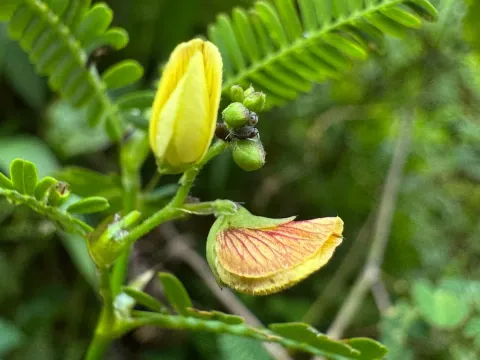
Aeschynomene sensitiva
Aeschynomene sensitiva
Aeschynomene sensitiva is a tropical annual legume that requires consistent warmth and moisture to establish successfully, making the start of the rainy season the ideal sowing time.
What the section contains
Aeschynomene sensitiva
Seeds should be sown in prepared beds, ensuring good contact with the soil to maximize water uptake, which is crucial for the germination of this species.
Row planting is generally recommended when the plant is used for soil improvement, allowing for easy management and uniform distribution of biomass.
Because the seeds have a naturally hard seed coat, pre-sowing treatments such as scarification are often necessary to ensure uniform emergence in field conditions.
Optimal spacing should be maintained to prevent overcrowding while ensuring that the canopy closes quickly to suppress potential weed growth between rows.
As a member of the Fabaceae family, Aeschynomene sensitiva is highly valued for its symbiotic relationship with nitrogen-fixing bacteria, which enriches soil fertility.
This crop is uniquely adapted to waterlogged environments, thriving in conditions where most other legumes would suffer from root suffocation and decay.
The plant performs best in tropical climates where temperatures remain consistently high throughout the growing season, as it is highly sensitive to cold stress.
Regarding soil requirements, it is surprisingly tolerant of various textures, though it prefers slightly acidic to neutral soils that retain moisture efficiently.
- Excellent tolerance to flooded soil conditions.
- Significant nitrogen fixation capabilities.
- Preference for consistent high temperatures.
The primary agricultural objective for cultivating Aeschynomene sensitiva is the production of biomass to be used as green manure or a cover crop.
By producing substantial amounts of organic matter, the plant helps improve soil structure and replenishes nitrogen levels depleted by preceding crops like rice.
Harvesting usually occurs at the early flowering stage, as this is when the nutrient content in the biomass is at its peak and the stems are still tender.
While primarily a soil-improvement crop, it has been explored for fodder potential in specific regions, provided that intake is managed appropriately for livestock safety.
High yields are achievable under conditions of high humidity and adequate sunlight, providing a sustainable way to maintain soil productivity in tropical systems.
Insects such as leaf beetles and various species of weevils are the most common pests that can affect the plant's leaf area and overall growth rate.
Fungal pathogens pose a significant threat during periods of excessive humidity, leading to damping-off in seedlings or stem rot in more mature plants.
Management of these threats involves monitoring the crop during the early stages and utilizing integrated pest management strategies to reduce chemical dependence.
Crop rotation remains the most effective defense against soil-borne pathogens, ensuring that the field is not kept under this legume for too many consecutive cycles.
Maintaining a balanced ecosystem around the field can help naturally manage pest populations, keeping them below levels that would necessitate intensive intervention.