
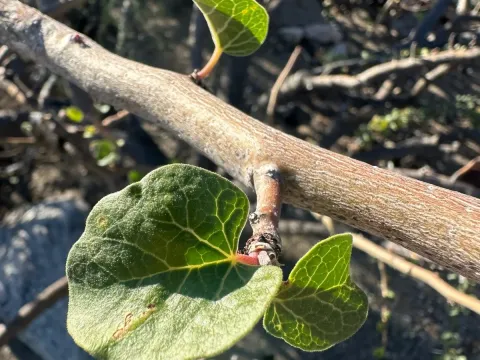
Ashy Jatropha
Jatropha cinerea
Ashy Jatropha is a perennial shrub, meaning that seeding is not an annual requirement. Sowing is typically carried out in well-warmed soil at the start of the rainy season, ensuring optimal moisture levels for germination.
What the section contains
Ashy Jatropha
Freshly collected seeds are generally used for propagation, often soaked beforehand to accelerate the emergence of sprouts. The planting depth usually ranges from 2 to 4 centimeters depending on the texture of the soil substrate.
The plant can also be successfully propagated via cuttings, which helps preserve specific varietal traits and reduces the time required until the onset of fruit production. Cuttings are planted in nurseries with moderate watering and shading during the initial root-development phase.
When propagating by seed, it is important to maintain spacing between plants of at least 2 meters to ensure the full development of the adult shrub's canopy.
The optimal temperature range for seed germination and the active growth of young Ashy Jatropha seedlings is between +25 and +32 degrees Celsius.
Ashy Jatropha belongs to the Euphorbiaceae family and is a typical representative of xerophytic flora, perfectly adapted to survival in desert and semi-desert conditions.
The crop has minimal requirements for soil fertility, successfully growing in sandy, rocky, and limestone soils that are typically poor in nutrients.
The plant possesses exceptional drought tolerance and can survive long periods without rainfall due to its specific stem anatomy and a robust, deep root system.
A primary requirement is the provision of excellent drainage, as water stagnation in the root zone can lead to fungal infections and the potential death of the plant.
In its native range—northwestern Mexico—the crop prefers well-lit areas, as shade causes excessive stem elongation and reduces overall yield productivity.
The yield of Ashy Jatropha depends directly on the amount of precipitation during the growing season and the age of the bush, as fruiting begins in the 2nd to 3rd year after planting.
The primary value lies in the seeds, which contain a significant percentage of non-edible oils that can be utilized in the production of biodiesel or technical lubricants.
Yield indicators in wild populations are quite unstable; however, with targeted agronomic support, the volume of seed collection increases significantly.
Harvesting requires manual labor because fruit ripening often occurs unevenly, making mechanized harvesting difficult for this specific crop.
After separating the seeds from the fruit capsules, they are dried under direct sunlight, which is necessary to prevent spoilage during long-term storage.
The main pests of Ashy Jatropha include various types of aphids and spider mites, which attack young foliage under high-temperature and low-humidity conditions.
Root rots pose a serious threat only in cases of soil waterlogging or the use of heavy, poorly aerated soils during cultivation.
The plant contains toxic substances in its sap, which provides natural protection against most herbivores but requires caution when performing maintenance tasks.
To prevent the spread of pests, it is recommended to maintain proper ventilation within the plantations and to promptly remove any damaged or dry branches.
In industrial-scale operations, it is crucial to control the spread of sooty mold, which can colonize pest secretions and hinder the plant's photosynthesis process.
Harvesting begins as the fruit capsules turn brown, as they may crack upon maturation, causing seeds to disperse naturally around the bush base.
To prevent seed loss, it is recommended to conduct the harvest in stages, selecting only fully formed dark brown capsules.
The collected material must be cleaned of plant debris, as the presence of impurities lowers the quality of the final technical oil during the subsequent pressing stage.
After harvesting, seeds should be stored in a cool, dry place, as high humidity leads to the rancidity of the oils contained within the seed kernels.
The yield per bush varies based on planting density, with peak productivity typically reached between 5 and 10 years of age.