
Aleppo spurge
Euphorbia aleppica
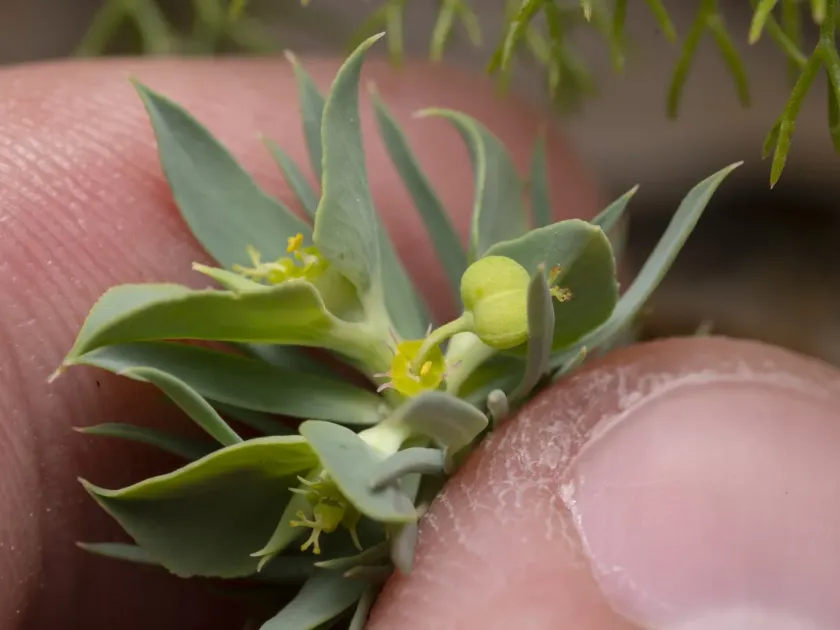
Description
Growing requirements
Aleppo spurge (Euphorbia aleppica) is a herbaceous annual plant belonging to the Euphorbiaceae family. In an agricultural context, it is recognized as a weed that competes for resources in cultivated fields and pastures.
The native range of this species extends across the Mediterranean basin and Western Asia. It has successfully adapted to disturbed habitats, including arable land, roadside embankments, and abandoned fields, where it can form dense colonies.
From a botanical perspective, the plant typically grows between 10 to 40 centimeters tall with a branched stem architecture. Its leaves are narrow and linear, and like all Euphorbias, it produces a white, caustic latex when the tissues are damaged.
Regarding its habitat requirements, Aleppo spurge thrives in well-drained, sun-exposed soils. It exhibits significant drought tolerance, allowing it to survive in regions with hot, dry summers where other vegetation might wither.
Effective management strategies include cultural practices such as crop rotation and the use of pre-emergent herbicides. Because the plant is toxic due to its milky sap, it is considered a hazard if it enters the fodder supply for livestock.
Main diseases and pests
Aleppo spurge is remarkably resistant to most common plant diseases. Its toxic latex serves as a chemical defense mechanism, deterring most herbivores and pathogens from colonizing the plant tissues.
While disease pressure is low, certain specialized insects, such as sphinx moth larvae, may feed on the foliage. These biological interactions are usually not sufficient to eradicate the weed population in a commercial field setting.