
Hevea
Hevea
Hevea brasiliensis, the Para rubber tree, is a flowering plant belonging to the Euphorbiaceae family and serves as the primary global source of natural rubber.
What the section contains


Hevea
Native to the Amazon rainforest, this species has been successfully introduced to tropical regions worldwide, specifically Southeast Asia, which dominates global production today.
The crop thrives in hot, humid tropical climates where temperatures remain consistently between 23 and 30 degrees Celsius throughout the year.
Adequate rainfall is critical for maintaining high sap pressure, which is essential for consistent latex production throughout the life cycle of the tree.
The tree requires well-drained, deep, acidic soil conditions to prevent root suffocation; it is intolerant of waterlogged areas which foster harmful fungal growth.
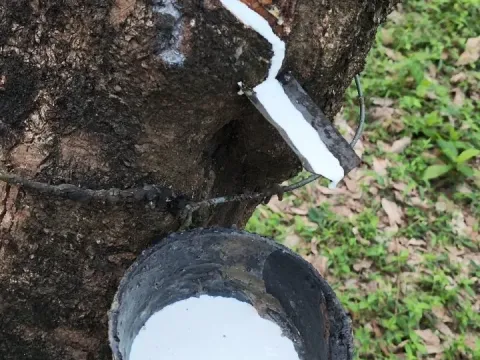
The economic value of Hevea is derived from its latex, a milky white sap extracted by carefully slicing the bark, a process known as rubber tapping.
Typically, trees are ready for commercial tapping when they reach a trunk circumference of approximately 50 centimeters, usually at 5 to 7 years of age.
A well-managed plantation can remain productive for 25 to 30 years, after which the wood is harvested and processed for the furniture industry.
Yields are heavily influenced by the use of high-yielding clonal varieties, proper soil nutrient management, and the skill of the tapper executing the incision.
Efficient management allows a plantation to produce several tons of dry rubber per hectare annually, making it a cornerstone of the global polymer industry.
The most significant threat to global production is the South American leaf blight, caused by the fungus Microcyclus ulei, which defoliates trees and stops latex flow.
Phytophthora leaf fall and bark rot are also common pathogens that negatively impact tree health and productivity in high-humidity zones.
Various insect pests, including bark borers and mites, can cause structural damage to young saplings, requiring integrated pest management strategies.
Effective management includes maintaining proper tree spacing to improve airflow and selecting disease-resistant clones during the initial planting phase.
Biosecurity measures and strict nursery protocols are essential to prevent the spread of invasive pathogens between different geographic rubber-growing zones.
Latex harvesting is performed through precise incision of the bark, carefully slicing the laticiferous vessels without cutting into the tree's cambium layer.
Tapping is traditionally carried out in the early morning hours to take advantage of the tree's internal water balance and maximize the volume of collected sap.
Once collected, the liquid latex is transported to processing facilities where it is coagulated using acetic or formic acid before being pressed and dried.
The frequency of tapping is carefully calibrated to the tree's recovery rate; over-tapping can cause severe physiological stress and reduce the total life span.
Ongoing research focuses on automated tapping tools to reduce human error and improve the consistency of bark consumption over the productive life of the tree.