
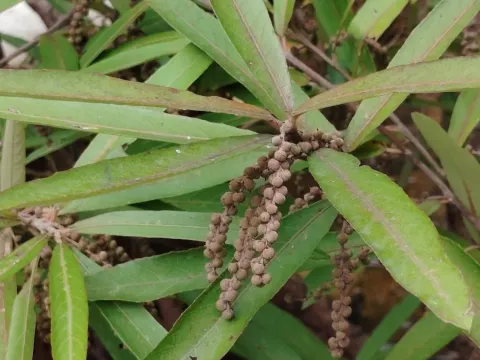
Homonoia
Homonoia
Homonoia is a genus of flowering plants in the family Euphorbiaceae. These plants are primarily native to the tropical regions of Southeast Asia, ranging from India to the Philippines, where they thrive in specific riparian environments.
What the section contains

Homonoia
Botanically, these plants are known as rheophytes, meaning they have evolved to grow in fast-flowing water, typically anchoring themselves among rocks and gravel along riverbanks. This unique adaptation allows them to withstand periodic submersion.
To successfully cultivate Homonoia, one must replicate their natural environment by providing consistent soil moisture. The ideal substrate is a coarse, well-draining mixture that prevents water stagnation while ensuring roots remain hydrated.
Climate requirements for this genus are stringent; they require tropical conditions with high humidity and consistent warmth. They are not frost-hardy and will experience significant physiological stress if temperatures drop significantly.
In terms of agricultural management, maintenance involves regular monitoring of light levels to prevent scorching during peak tropical sun. Propagation is typically achieved through vegetative cuttings, which require high humidity levels to successfully root.
The most common disease affecting Homonoia is root rot, which typically occurs due to poor drainage or inadequate water aeration in containers. This leads to rapid decline, starting with wilting and browning leaves.
Spider mites are a persistent threat in indoor or greenhouse settings where the ambient air becomes too dry. These pests thrive in warm conditions, causing stippling and eventual leaf drop if left untreated.
Aphids tend to colonize the succulent tips of young shoots, extracting phloem sap and reducing the plant's overall vigor. Regular inspection of new growth is essential for early detection of these infestations.
Mealybugs can also infest the plant, hiding within leaf axils where they are protected from topical treatments. Manual removal or the application of systemic pesticides may be required for severe infestations.
Scale insects present another challenge, attaching themselves to woody stems and leaves. Controlling them requires persistent treatment, as their hard protective shells make them resistant to many contact insecticides.