
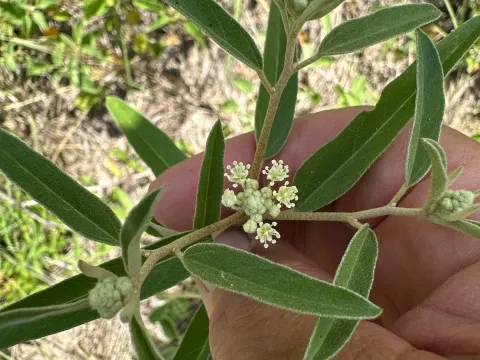
Texas croton
Croton texensis
Texas croton (Croton texensis) is an annual herbaceous plant belonging to the Euphorbiaceae family. It is widely recognized for its resilience and ability to colonize disturbed soils, functioning as an important pioneer species in its native ecosystems.
What the section contains
Texas croton
The plant is native to North America, specifically the central and southern regions of the United States and northern Mexico. It typically thrives in arid prairies, sandy plains, and along roadsides, demonstrating a strong tolerance for heat and dry conditions.
Botanically, it forms a highly branched structure reaching heights of 20 to 80 cm. The foliage is characterized by lanceolate to linear leaves covered in dense, stellate hairs, which provide structural protection against evaporation and high UV radiation.
As a true xerophyte, Texas croton requires full sun exposure and performs best in light, well-drained, sandy or sandy-loam soils. It is highly sensitive to waterlogged conditions, which can inhibit growth and promote root failure.
Economically, the species is investigated for its oil-rich seeds, which present potential for various industrial applications. Furthermore, its extensive root system makes it a candidate for stabilizing loose soil in areas prone to erosion.
The most significant threats to Texas croton include fungal pathogens that target the root system, especially under conditions of high soil moisture or poor drainage. Root rots represent the primary physiological risk to the crop's long-term survival.
Common pests include spider mites and aphids, which feed on the sap of the plant. Significant infestations can cause leaf curling and a marked decrease in vigor, eventually reducing the overall seed yield if not managed through proper field observation.
While the milky sap contains latex and alkaloids that deter many generalist herbivores, certain specialized leaf-feeding insects can cause damage. Managing these threats usually involves maintaining healthy, stress-free plants that can naturally withstand light herbivory.
Viral infections may occur, often transmitted by insect vectors such as whiteflies. Symptoms include mottling or mosaic patterns on the foliage, which require the immediate removal of affected plants to prevent further spread across the plot.
The most effective strategy for pest and disease management is a combination of cultural practices, such as ensuring adequate spacing between plants and avoiding water accumulation. Chemical intervention is rarely necessary for this hardy species.