
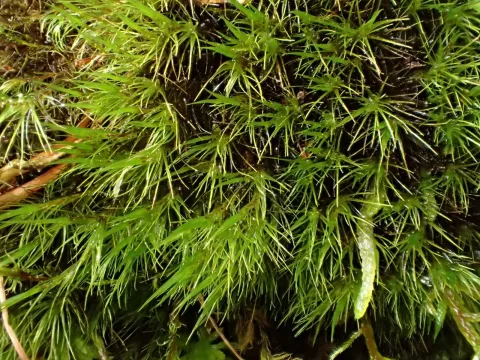
Campylopus setifolius
Campylopus setifolius
Campylopus setifolius is a perennial moss belonging to the Dicranaceae family. While it is not a traditional crop in commercial agriculture, it is of significant interest to researchers studying wetland ecosystems and bryological biodiversity in oceanic climates.
What the section contains
Campylopus setifolius
The plant typically thrives in humid, acidic environments, particularly on peat soils or moist cliff faces within its native range. This range is predominantly located along the Atlantic coasts of Europe, including Ireland and western parts of the United Kingdom.
Botanically, it forms dense, compact tufts with characteristic bristle-like leaves that are slightly curved at the tips. This specific morphology is a key adaptation for capturing moisture from the atmosphere and surviving the high humidity of its habitat.
The environmental requirements for Campylopus setifolius are strict, focusing on constant moisture, mild temperatures, and clean air. It cannot be grown using conventional agricultural techniques as it relies on specific ecological niches that are difficult to replicate artificially.
From an ecological management perspective, the plant is considered a bio-indicator. Its presence suggests stable hydrological conditions and low levels of pollution, making it an essential component of local moorland and bog conservation efforts.
The primary threats to this species include wetland drainage and habitat loss due to land development. The alteration of natural hydrological cycles negatively impacts the growth and long-term survival of moss colonies that are sensitive to desiccation.
Additionally, competition with invasive plant species driven by nitrogen deposition or changing atmospheric conditions can pose a risk to established populations. Climate change also represents a long-term challenge due to its potential to disrupt the specific thermal and moisture balance needed by the moss.