
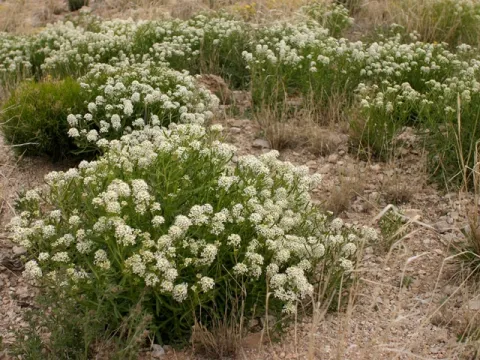
Mountain pepperweed
Lepidium montanum
Mountain pepperweed is primarily sown in the spring season once the soil warms up to temperatures between 8 and 10 degrees Celsius. The optimal time for planting is the beginning of the field work season, which allows the plant to maximize the utilization of soil moisture reserves for seed germination.
What the section contains
Mountain pepperweed
To ensure a stable yield, both row and wide-row sowing methods are practiced, depending on the intended use of the crop. The seed planting depth should not exceed 1 to 1.5 centimeters, as small seeds require high-quality soil contact and good exposure to light.
In regions with moderate climates, late-autumn sowing is possible, allowing the crop to start vegetation earlier in the spring. Seeds are capable of maintaining viability during brief temperature drops, making them suitable for early planting windows.
After mass emergence, thinning is recommended to ensure each plant has a feeding area of at least 15–20 square centimeters. Overcrowded plantings lead to stem elongation and a decrease in the quality of the green mass.
The use of modern precision seeders allows for the optimization of seed material consumption and minimizes labor costs during the care phase of young seedlings.
Mountain pepperweed belongs to the Brassicaceae family and prefers open, well-lit areas. The crop is characterized by high adaptability to various soil types, although it shows the best results on light sandy and loamy soils with a neutral pH.
The plant has a pronounced xerophytic nature, which allows it to withstand short periods of drought. However, to form succulent greens, moderate and regular irrigation is required during the phase of active growth.
The optimal temperature range for the development of the crop varies between 16 and 22 degrees Celsius. At excessively high temperatures and with a moisture deficit, the plant begins to transition prematurely to the generative phase, which degrades the quality of the marketable product.
Soils for cultivation must have good drainage, as waterlogging has an extremely negative effect on the condition of the root system. A high humus content contributes to the rapid development of vegetative mass.
The culture demonstrates high resistance to unfavorable abiotic factors in alpine zones, where it originates, making it promising for adaptation in regions with variable climates.
The yield of mountain pepperweed directly depends on the intensity of agrotechnologies and the quality of care. Under intensive cultivation using fertigation, a significant volume of green mass can be obtained from each hectare of crops.
The market maturity of the crop is reached quite quickly, which allows for several harvest cycles in a single growing season under favorable weather conditions.
The economic efficiency of cultivation is determined by the low cost of production and the potential for selling it as a valuable spicy-flavored herb. Harvesting is conducted at the stage of rosetted leaf formation.
Factors influencing the mass of the marketable product:
- Adequate nitrogen fertilizer supply during the initial growth period.
- Regular irrigation and maintenance of soil moisture.
- Timely weed control between rows.
The biological potential of the species allows for a high yield of vitamin-rich products if optimal plant density is maintained.
The main threats to this crop are typical diseases of the Brassicaceae family, such as clubroot and various types of rot. To minimize risks, it is necessary to follow crop rotation and not return the crop to the same field earlier than three years later.
Among pests, the greatest danger is posed by flea beetles, which can destroy young seedlings within a few days. For crop protection, both agrotechnical methods and modern biological products are used.
Aphids and cabbage moth larvae can also cause damage to the leaf mass, reducing the marketability of the product. Monitoring the state of the crops for pest detection should be conducted weekly.
Disease prevention includes the use of high-quality treated seed material and the maintenance of optimal planting density to prevent high air humidity.
Upon detection of initial signs of fungal infection, fungicides with a short waiting period are applied, which is especially important for crops intended for consumption.
The harvest of mountain pepperweed is carried out selectively or mechanically depending on the scale of production. The optimal moment is considered to be the period when the leaves reach the typical color and shape for the variety before intensive bolting begins.
Cut greens must be promptly moved to a cool place to prevent loss of turgor and moisture evaporation. The high speed of metabolic processes requires rapid primary processing after harvesting.
To preserve market appearance and nutritional value, the harvested product is packaged in ventilated containers. Short-term storage is carried out in refrigeration chambers at a temperature of about 2–4 degrees Celsius.
The harvesting process must exclude contamination of leaves with soil particles, which is achieved through careful field preparation and the use of special harvesting platforms.
Sorting products by size and leaf condition allows for increased product value upon delivery to sales markets.