
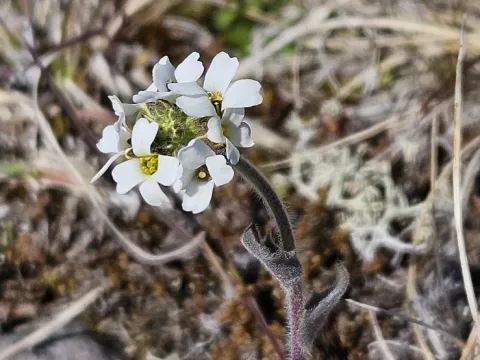
Norwegian whitlow-grass
Draba norvegica
Norwegian whitlow-grass (Draba norvegica) is a perennial herbaceous plant belonging to the Brassicaceae family. It is a highly specialized species that thrives in challenging arctic and alpine environments, displaying remarkable adaptation to low temperatures and short growing seasons.
What the section contains
Norwegian whitlow-grass
The plant originates from the mountainous and high-latitude regions of Europe and North America. It is typically found in rocky habitats, scree slopes, and tundras where competition from taller vegetation is limited by the harsh climatic conditions and poor soil quality.
Regarding cultivation requirements, the species demands high levels of light and excellent soil drainage. It is physiologically programmed to survive in environments where soil nutrients are scarce, making it a candidate for studying plant hardiness in extreme climates.
The botanical structure of Draba norvegica includes a compact basal rosette of leaves and slender stems that produce small, white, four-petaled flowers. The fruit consists of silicles, which are characteristic of the Brassicaceae family, ensuring efficient seed dispersal by wind.
In terms of agricultural or economic use, the plant is primarily a wild species with significant value in ecological research. Agronomists monitor such species to understand cold-tolerance mechanisms that could potentially be applied to crop improvement programs in northern regions.
The main threats to the plant include environmental degradation due to global warming and the encroachment of non-native plant species into fragile alpine habitats. Disease pressure is generally low in the wild, but localized outbreaks of mildew can occur in excessively humid conditions.