
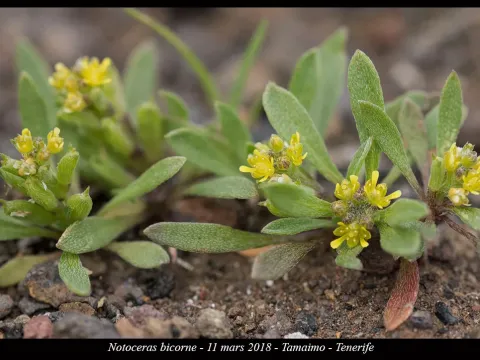
Notoceras
Notoceras
Notoceras, specifically the species Notoceras bicorne, is a member of the Brassicaceae family. It is an annual herbaceous plant native to arid and semi-arid regions of the Middle East and North Africa, adapted to survive in harsh, moisture-limited environments.
What the section contains

Notoceras
The sowing window for this crop is primarily determined by the onset of favorable spring temperatures. In its native climate, seeds are sown when the soil warms sufficiently, usually following the final frost, ensuring rapid germination and early root development.
Optimal planting depth is between 1 and 2 centimeters. Due to the small size of the seeds, precise soil contact is crucial to ensure consistent emergence. The use of precision seeders helps maintain uniformity and prevents issues with crusting or poor establishment.
Row spacing should be planned at approximately 25–30 centimeters. This density allows for efficient mechanical weeding and ensures that individual plants receive adequate exposure to light and air circulation, which is vital for reducing the risk of humidity-related pathogens.
Site selection is critical, as Notoceras thrives in well-drained, light-textured soils. Avoid fields with low-lying areas that are prone to water stagnation, as the plant is highly sensitive to root-level moisture saturation, which can severely hinder its performance.
As a true xerophyte, Notoceras requires high levels of solar radiation and low relative humidity to thrive. It is biologically tuned to complete its lifecycle quickly during the availability of seasonal moisture, making it an excellent candidate for drought-prone farming.
Soil requirements for Notoceras are modest; it prefers well-aerated, sandy, or loamy substrates. It exhibits a remarkable tolerance to alkaline soil conditions, thriving in pH ranges that might otherwise limit the growth of more traditional cereal or vegetable crops.
Temperature plays a defining role in the plant's development. It performs optimally under conditions ranging from 20 to 35 degrees Celsius. It possesses efficient metabolic pathways that allow it to continue photosynthesis even when daytime temperatures are high.
Water requirements are minimal, and irrigation should only be supplementary. If irrigation is used, it should be strictly managed to prevent waterlogging. Excessive watering acts as a stressor, rather than a benefit, for this specific desert-adapted species.
Nutrient management focuses on phosphorus availability to encourage strong root architecture. Excess nitrogen should be avoided to prevent the plant from producing excessive vegetative growth, which can lead to lodging and a reduction in the harvestable seed yield.
The main pathological threats to Notoceras include various fungal diseases such as powdery mildew, which can develop rapidly if environmental conditions become excessively humid or if ventilation between plants is restricted by improper planting density.
Insect pests commonly associated with the Brassicaceae family, particularly flea beetles, pose the greatest threat during the seedling stage. These pests can rapidly defoliate young plants, causing significant stand loss early in the season.
Root rots are primarily a symptom of poor site management, occurring when the plant is subjected to poor drainage or overly compacted soils. Such conditions provide the ideal environment for soil-borne pathogens to infiltrate and damage the vascular system of the plant.
Effective pest management involves an integrated approach. This includes the use of certified, treated seeds to protect the plant during the critical emergence phase, as well as scouting to apply insecticides only when economic thresholds are reached.
Preventative cultural practices, such as maintaining a strict crop rotation schedule that avoids planting Notoceras on land previously occupied by other crucifers, remain the most effective strategy for reducing the pressure from specialized pests and soil-borne diseases.