
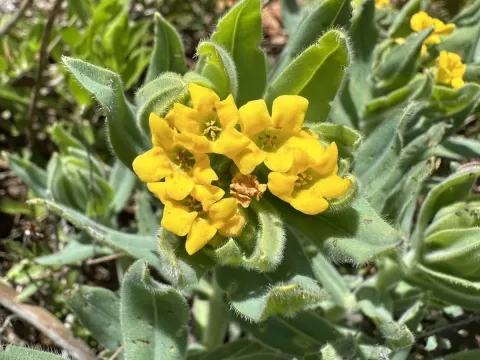
California gromwell
Lithospermum californicum
Sowing of California gromwell is mainly carried out in the spring period when the soil warms up to 10-12 degrees Celsius. To obtain uniform germination, the seeds require pre-stratification for several weeks in cold conditions.
What the section contains
California gromwell
The seeding depth is 1-2 centimeters, as the culture is sensitive to planting depth. It is important to ensure stable substrate moisture during the first two weeks after sowing for successful germination.
The planting scheme should take into account the bush expansion, so a distance of 30-40 centimeters between plants is considered optimal. This ensures sufficient ventilation and reduces the risk of fungal diseases.
In industrial conditions, seeds are often sown in trays to produce seedlings, which are then planted in the ground at the age of 40-50 days. This method allows for minimizing losses during field cultivation.
Winter sowing is possible in regions with mild winters, during which the seeds undergo natural hardening in the soil, which contributes to earlier and more intensive plant growth in the spring.
California gromwell belongs to the Boraginaceae family and is a perennial herbaceous plant with a deep root system. In the wild, it grows on rocky slopes of North America, which determines its high requirements for drainage.
The crop prefers well-lit areas with direct sunlight, as the stems become weak and flowering is almost absent in the shade. Excessive moisture and stagnant water are destructive to this species.
Soils should be light, sandy, or rocky, with a neutral or slightly alkaline pH. Heavy clay soils require the addition of loosening materials such as sand or gravel.
The plant has high drought resistance and can withstand long periods without watering after rooting. However, for obtaining quality raw materials in agronomy, moderate watering is recommended during the active growth phase.
The culture is adapted to climates with a distinct dry summer season and cool winters, which should be taken into account when choosing a location for commercial cultivation.
The main danger for California gromwell is root rot caused by soil waterlogging or stagnant water in the root zone. For prevention, it is necessary to use well-drained substrates.
Under crowded planting conditions, plants can be susceptible to powdery mildew, which manifests as a white coating on the leaves. Control involves using sulfur-based fungicides and improving field aeration.
Among pests, aphids and spider mites are frequently found on the crop, especially during dry periods. When the first individuals are detected, it is recommended to use biological insecticides to maintain the quality of eco-friendly raw materials.
Slugs can damage young gromwell sprouts in the spring, especially during rainy weather. Using gravel mulch serves as an excellent barrier against the movement of these pests.
Compliance with crop rotation is a mandatory condition for preventing the accumulation of pathogens in the soil. It is not recommended to return the crop to the same place for at least four years.