
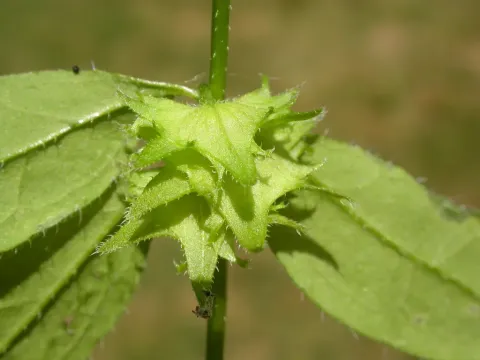
Madwort
Asperugo
Madwort (Asperugo procumbens) is a unique annual herb belonging to the Boraginaceae family. It is the only member of its genus, widely recognized for its rough, scrambling stems covered in hooked prickles that allow it to cling to surfaces.
What the section contains
Madwort
The stems can grow up to 60-80 centimeters in length and are often prostrate or trailing. The leaves are typically lanceolate and arranged alternately along the stem, providing an efficient surface for growth in varied environmental conditions.
The plant produces small, blue to violet flowers that are hidden in the leaf axils. As the seeds mature, the calyx expands and becomes rigid, which is an evolutionary adaptation to assist in seed dispersal via attachment to passing animals.
Its natural range covers vast areas of Eurasia. In agricultural contexts, madwort is generally treated as an unwanted weed found in disturbed habitats such as roadsides, waste areas, and nutrient-rich farmyards.
It prefers soils with high nitrogen content and sufficient moisture. While not a cultivated crop, its presence serves as an indicator of soil fertility, often highlighting areas where organic matter accumulation is high.
Madwort is resilient but can fall victim to common fungal pathogens like powdery mildew, especially in environments with poor air circulation or excessive humidity levels.
Insect pests that target Boraginaceae, including various leaf beetles and aphids, may occasionally utilize madwort as a host plant, potentially acting as a vector for viruses that affect primary crops.
Effective management strategies involve early mechanical cultivation to disrupt root systems before the plant enters its reproductive stage and produces its characteristic spiny fruit.
Chemical control programs involving pre-emergent or post-emergent herbicides can be effective if integrated into a broader weed management plan to ensure long-term site cleanliness.
Maintaining high crop canopy density is the most effective biological control method, as madwort struggles to compete for light when shaded by fast-growing, vigorous agricultural plants.