
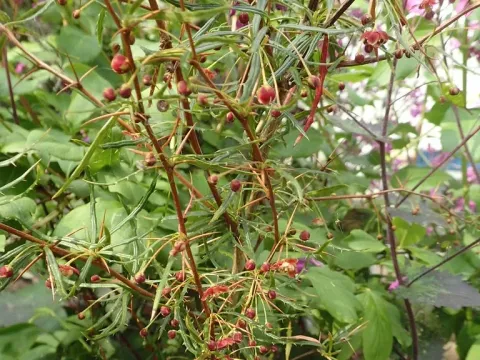
Three-spine barberry
Berberis triacanthophora
The Three-spine barberry (Berberis triacanthophora) is an evergreen or semi-evergreen shrub belonging to the Berberidaceae family. It is native to Central China and is highly valued in horticulture for its elegant foliage and distinctively long, three-parted spines.
What the section contains
Three-spine barberry
Regarding climate, this shrub thrives in regions with moderate winters. While it is hardy once established, young plants may require protection from frost and cold winds in northern latitudes. It prefers sunny locations to maintain its foliage color and compact growth habit.
The soil requirements are specific: the plant demands well-drained, fertile soil with a neutral to slightly alkaline pH. It is highly sensitive to waterlogged conditions, which can quickly lead to root rot; therefore, good site drainage is essential for healthy development.
As a landscape feature, this species is excellent for defensive hedging. The plant responds well to regular pruning, which encourages denser branching and makes it an effective barrier against wildlife or trespassers.
Cultural maintenance involves routine irrigation during extreme dry spells and annual soil fertilization in early spring to support rapid growth and development of the characteristic colorful new leaves.
The main phytopathological threats include fungal infections such as powdery mildew and leaf rust, which often occur when humidity is high and airflow within the shrub canopy is insufficient.
Insect pests, including the barberry aphid and various lepidopteran larvae, pose a significant risk during the growing season. These pests feed on succulent tissues, leading to leaf deformation and potential plant stress.
Effective management strategies include cultural practices like proper spacing and site sanitation. Removing infected or dead wood during the pruning process helps reduce the overwintering population of pathogens.
Chemical control should be targeted, using appropriate fungicides during the early stages of disease progression and selective insecticides only when pest populations exceed economic thresholds.
Regular inspection of the undersides of leaves is critical for early detection of aphid colonies, allowing for prompt intervention before widespread damage to the shrub's aesthetic appearance occurs.