
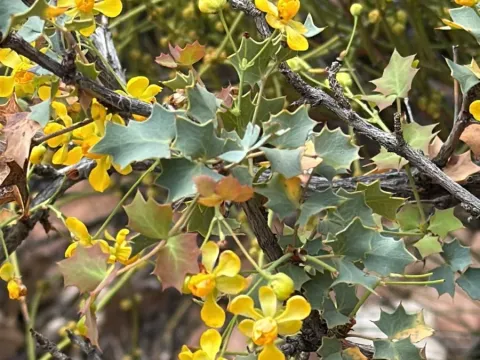
Fremont's barberry
Berberis fremontii
Fremont's barberry (Berberis fremontii) is an evergreen or semi-evergreen shrub belonging to the Berberidaceae family. In the wild, this species is native to the arid regions of the Southwestern United States, specifically Arizona, Utah, Nevada, and Colorado.
What the section contains
Fremont's barberry
The plant exhibits high adaptability to arid environments and thrives in open, sun-exposed areas. In its natural habitat, the shrub is found on rocky slopes, foothills, and open desert plateaus, which dictates its exceptional drought tolerance.
The species has specific soil requirements: it needs light, well-drained soils with a neutral or slightly alkaline pH. Heavy, clay-based, and waterlogged soils are detrimental to the plant's root system, making it essential to provide a high-quality drainage layer during planting.
The climatic hardiness of Fremont's barberry allows it to withstand significant temperature fluctuations and moderate frosts; however, it reacts poorly to excessive air and soil moisture during winter. In colder regions, cultivation is primarily possible in protected areas or as a container plant.
In agronomy, the culture is valued for its low-maintenance nature once established. Regular watering is only necessary during the first year to develop the root system; thereafter, the shrub can sustain itself through moisture absorption from deep soil horizons.
Despite its high vitality, Fremont's barberry can be affected by fungal diseases if the agronomic regime is violated, such as during excessive watering. The most common problem is powdery mildew, which occurs when air circulation around the canopy is poor.
Rust on leaves may also develop, often as a result of high humidity and lack of ventilation in dense plantings. Proper spacing of plants at least two meters apart serves as an effective preventive measure against these pathogens.
Among pests, various aphid species pose the greatest threat, as they colonize young shoots and feed on sap. Early detection allows for effective management using soap solutions or specialized biological insecticides.
Occasionally, barberry fruit moth larvae may be found on the bushes, damaging the developing fruit. Monitoring the canopy throughout the spring and summer allows for timely intervention to protect the crop or the plant's ornamental appeal.
To maintain the shrub's health, it is essential to perform annual sanitary pruning by removing dry, damaged, or overcrowded branches, which improves air circulation and reduces the overall risk of disease transmission.