
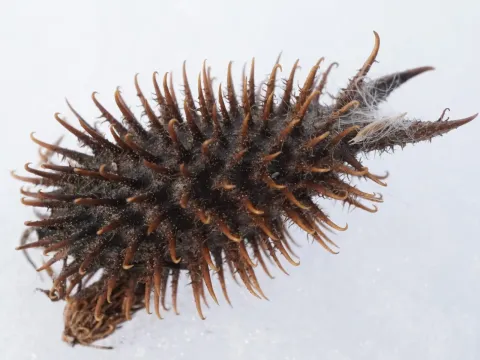
Large-flower cocklebur
Xanthium speciosum
Large-flower cocklebur (Xanthium speciosum) belongs to the Asteraceae family. It is an annual herbaceous plant, often recognized in agricultural settings as a competitive weed that necessitates systematic control measures to protect crops.
What the section contains
Large-flower cocklebur
The biological development cycle initiates in spring when soil temperatures reach 12–15°C. The seeds possess significant dormancy, allowing them to remain viable within the soil seed bank for several growing seasons.
Seedling emergence is often uneven, presenting challenges for farmers planning effective protection strategies. Early-season vegetative growth allows the plant to rapidly accumulate biomass and outcompete young crop plants.
Mass development occurs during stable warming periods. The plant demonstrates high germination energy, securing a competitive advantage during the initial stages of establishment within agricultural ecosystems.
Optimal timing for agrotechnical control measures is before the flowering stage, preventing the reallocation of resources toward the production of mature, spiny burrs.
This species favors well-lit areas with moderate to high moisture levels. It shows remarkable plasticity regarding soil composition, thriving in various types ranging from heavy loams to sandy soils.
Soil fertility requirements are moderate; however, the plant is highly responsive to nitrogen availability, which significantly enhances its growth rate and vegetative vigor. Early competition-free periods are critical for initial development.
Climatic conditions are crucial for the lifecycle; the plant is heat-loving and requires a sufficient accumulation of active temperatures to ensure the production of viable, mature seeds inside the burrs.
Soil moisture directly influences germination intensity. Periods of drought may temporarily inhibit development, but the plant recovers efficiently following rainfall due to a strong, deep taproot system.
Agrotechnical management requires deep tillage and the strategic use of systemic herbicides, as the plant is known for its ability to adapt and emerge from dormant seed reserves.
Despite its high vitality, the plant is susceptible to specific pathogens, including powdery mildew and rust fungi, which can reduce photosynthetic efficiency and overall biomass accumulation.
Pests such as various moth larvae frequently target the reproductive structures, acting as a natural limiting factor for seed dispersal in natural and agricultural landscapes.
Integrated management is essential, involving crop rotation and the use of cover crops that restrict sunlight access to newly emerged seedlings.
Chemical control requires a multi-stage approach, applying herbicide tank mixtures during the early vegetative stages before the leaves develop a waxy cuticle that limits absorption.
- Timely inter-row cultivation
- Use of selective herbicides
- Strategic crop rotation
- Mechanical removal of hotspots
- Soil weed seed bank monitoring