
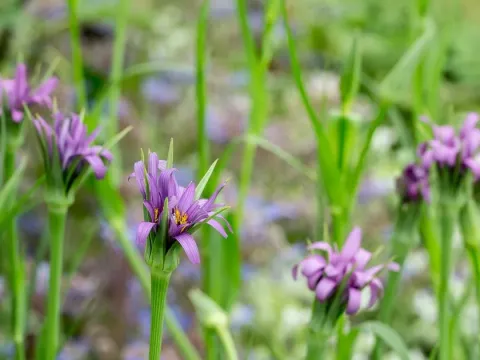
Tommasini's Salsify
Tragopogon tomasinii
Tommasini's Salsify, belonging to the Asteraceae family, is a root vegetable cultivated primarily as an annual or biennial crop. Optimal sowing times occur in early spring, as soon as the soil warms up to 5-8 degrees Celsius, ensuring favorable conditions for the development of the taproot.
What the section contains
Tommasini's Salsify
The ideal window for sowing is late March to early April. Winter sowing can be performed in October, allowing seeds to remain dormant until spring, which leads to earlier emergence, provided that the sowing depth is carefully managed at approximately 2-3 centimeters to ensure uniform germination.
The crop demonstrates significant cold tolerance, allowing young seedlings to withstand light frosts without substantial damage. Planting density should be planned with row spacings of 30-40 centimeters to provide adequate space for the taproot to reach its full potential size without competition.
During the germination phase, it is critical to maintain constant soil moisture, as the plant is sensitive to desiccation in the top layer. Once two to three true leaves appear, seedlings must be thinned to an interval of 10-15 centimeters between plants, which is essential for uniform root development.
Selecting the right location is vital; the plant prefers well-lit areas with light, deeply tilled soils. This is the primary requirement for obtaining straight, high-quality roots that are free from the branching and deformation that occur in compacted soils.
For successful cultivation of Tommasini's Salsify, light sandy loam or loamy soils with a deep arable layer are best. The presence of dense or rocky soils significantly reduces crop quality, often leading to twisted or malformed roots that are difficult to harvest and market.
The plant requires moderate and consistent irrigation but is highly sensitive to waterlogging, which can trigger root rot. An ideal soil pH is neutral or slightly alkaline, promoting better nutrient uptake throughout the growing season.
The optimal temperature range for active biomass accumulation is 18-22 degrees Celsius. During dry periods, supplemental watering is necessary because water stress negatively affects the succulence and culinary quality of the roots.
Agronomic practices include regular inter-row cultivation to improve soil aeration and effectively suppress weeds. The crop responds well to balanced mineral fertilizers; however, excessive nitrogen application during the later stages of growth should be avoided to prevent quality degradation during storage.
This species is highly adaptable to various climatic conditions, originating from the Mediterranean and Balkan regions, which makes it relatively low-maintenance compared to other root vegetables, provided that basic crop rotation is respected.
The yield of Tommasini's Salsify is primarily determined by soil preparation and timely agronomic intervention. Under favorable conditions, the roots reach technical maturity by the end of summer or early autumn, allowing for a predictable harvest schedule.
In intensive cultivation, the mass of a single root can range from 100 to 250 grams, contributing to solid commercial yields per hectare. Since the plant directs its energy mainly toward developing the taproot in the first year, providing conditions for deep soil penetration is key to higher yields.
Quality maintenance, including thinning and weed control, is essential for producing uniform roots that are valued for their taste and texture. This makes the crop an attractive option for both small-scale farming and specialized vegetable production markets.
Plant density is a major factor in yield optimization: proper spacing avoids resource competition, which directly influences individual root mass and overall market quality. Careful crop management ensures that the roots are harvested at their peak nutritional and physical state.
Harvesting can be done manually or mechanically, provided that the skin of the root remains intact. Preserving the integrity of the root surface is essential for ensuring a longer shelf life and preventing the development of storage diseases.
Common diseases affecting this crop include fungal infections such as powdery mildew, which thrives in high humidity and temperature fluctuations. Preventive application of fungicides during the early stages of symptom development is effective in controlling the spread.
Root rot occurs primarily due to waterlogging or failure to follow crop rotation cycles. To minimize this risk, it is important to avoid planting on the same site for at least 3-4 years to prevent the buildup of soil-borne pathogens.
Soil pests like wireworms and larvae of the cockchafer cause the most damage by feeding on the taproot, making the produce unsellable. Using soil-applied pest control measures and maintaining clean fields before planting are recommended strategies.
Aphids may infest the foliage during dry spells, sucking nutrients from the leaves and slowing down overall plant growth. Monitoring pest populations allows for timely interventions, preventing significant drops in root quality and weight.
Overall, the plant is quite resilient, and effective protection is achieved by combining preventive cultural practices, balanced soil moisture, and maintaining spatial isolation from other Asteraceae crops.
Harvesting Tommasini's Salsify typically begins in September or October when the root has reached its maximum development. Harvesting can be conducted gradually according to demand or as a single event for cold storage.
Before harvesting, cutting back the foliage is recommended to facilitate the operation and reduce the risk of damaging the roots. If mechanical harvesters are used, blade depth must be carefully calibrated to lift the roots cleanly from the soil without causing deformation.
Once harvested, the roots should be cleaned of soil, dried in a cool, ventilated area, and sorted to remove any damaged or diseased specimens. Optimal storage conditions require temperatures between 0 and 2 degrees Celsius and high humidity to maintain succulence.
A portion of the crop can be left in the ground until spring, protected by a layer of soil to prevent freezing in regions with harsh winters. These roots are often prized for their improved flavor and can be harvested immediately after the thaw, before new foliage appears.
The culinary use of this vegetable relies on its delicate flavor, often compared to asparagus or oysters. Because of its low starch content and high inulin concentration, it is an essential ingredient in healthy diets and high-end gastronomy.