
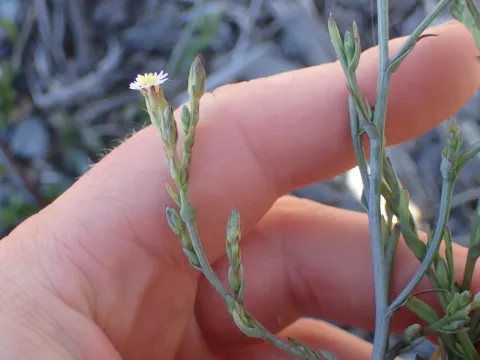
Saltmarsh aster
Symphyotrichum subulatum
Saltmarsh aster (Symphyotrichum subulatum) is a member of the Asteraceae family. It is an annual herbaceous plant known for its remarkable ability to colonize degraded environments, including saline agricultural fields.
What the section contains
Saltmarsh aster
Sowing should be performed in early spring once soil temperatures reach a stable level of 10–12 degrees Celsius. The seeds are very small and germinate rapidly when surface-level contact with the soil is maintained.
Standard agronomic practice involves row planting with spacing of 25–30 centimeters to allow for adequate airflow and plant development. Seed depth must not exceed 1–2 centimeters for optimal emergence.
The plant demonstrates high growth rates, quickly covering the soil surface. This rapid establishment makes it a competitive species that can quickly dominate an area if not properly managed through controlled sowing rates.
The biological cycle is efficient, with the plant producing a massive amount of wind-dispersed seeds by late summer or autumn, which must be considered in rotation planning to prevent unwanted spread.
The most important characteristic of this plant is its status as a halophyte. It thrives in high-salinity soil conditions where other common crops would fail due to osmotic stress.
It is an obligate heliophyte, requiring direct sunlight for its entire growth cycle. Shaded conditions lead to weak stems, reduced flowering, and a significant decrease in total biomass production.
The plant has a high tolerance for soil moisture variability. It can withstand temporary waterlogging, which is a common occurrence in the marshy or coastal habitats where it is naturally found.
Soil texture is less critical than chemical composition; the plant adapts well to both heavy clays and sandy soils, provided that the soil chemistry supports its specialized physiological needs for salt sequestration.
Climate requirements include a frost-free growing season. It is particularly well-adapted to warm-temperate and subtropical climates where it can complete its life cycle effectively within 4–6 months.
Major phytosanitary threats include fungal pathogens such as powdery mildew and root rot, which typically occur when humidity is high and soil drainage is poor during the active growing season.
Insect pests include aphids and mites, which can cause significant damage to foliage and flower heads, potentially reducing the overall quality of the harvested material for biomass or fodder.
Management of these threats involves cultural practices such as ensuring proper plant density, removing debris, and monitoring for early signs of infestation to avoid chemical applications.
The plant can also become a host for various aster-specific viruses, meaning that proper crop rotation and the destruction of infected residues are essential for maintaining field health.
Integrated pest management (IPM) strategies are recommended, focusing on maintaining plant vigor to help the crop naturally resist potential pest pressure and disease development.