
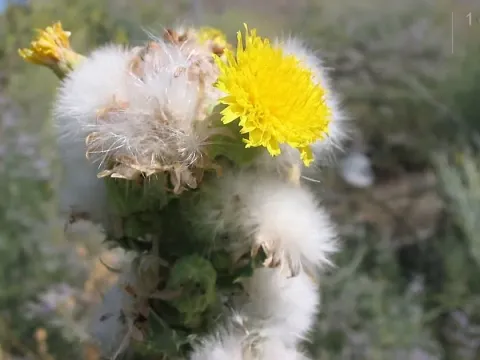
Thick-leaved sow thistle
Sonchus crassifolius
The thick-leaved sow thistle (Sonchus crassifolius) belongs to the Asteraceae family. This perennial herbaceous plant is specialized for survival in harsh, arid, or saline environments, showcasing remarkable evolutionary adaptations.
What the section contains
Thick-leaved sow thistle
The species thrives in high-light conditions and is most frequently observed in open habitats where solar exposure is maximal. Its ability to tolerate intense radiation is a key factor in its dominance in specific degraded ecosystems.
Botanically, the plant is distinguished by its succulent, thickened leaves that function as water-storage organs. This anatomical feature is essential for its survival in environments where precipitation is sporadic and unpredictable.
Soil requirements for Sonchus crassifolius include well-drained, porous media such as sandy loams. Poor drainage and soil compaction are detrimental to its root system, which requires significant oxygen exchange to maintain vigor.
Regarding climate, this plant exhibits high resilience to temperature fluctuations. It remains physiologically active across a broad spectrum of thermal conditions, which makes it a persistent competitor in various agricultural settings.
The most common disease impacting this species is powdery mildew, which manifests under high humidity. While the plant is drought-tolerant, excess moisture facilitates the spread of fungal spores across its leaves.
Insect pests such as aphids and spider mites represent significant threats. By colonizing the plant, these pests draw nutrients from the vascular system, often weakening the plant before it reaches its reproductive stage.
Rust fungi are another biological threat, leading to tissue necrosis. In fields where weed populations are dense, the accumulation of fungal pathogens can increase the inoculum load for adjacent agricultural crops.
Larval stages of soil-dwelling beetles can also inflict damage by feeding on the taproot. While the plant possesses strong regenerative capabilities, severe root damage restricts its ability to recover from mechanical stress.
Effective management involves integrated cultural practices. Regular mechanical removal and the use of targeted herbicides, applied early in the growth cycle, are essential to prevent seed dispersal and subsequent infestation of the field.