
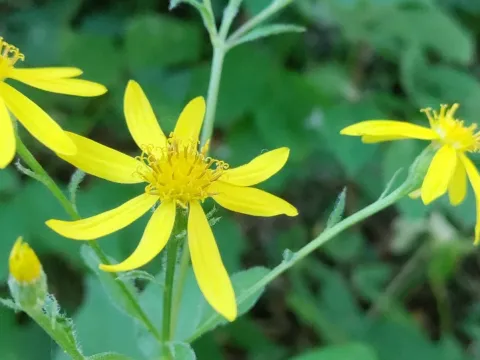
Woodland ragwort
Senecio nemorensis
Woodland ragwort (Senecio nemorensis) is a perennial herbaceous plant belonging to the Asteraceae family. Native to the forests of Europe and Asia, it typically grows in shaded environments such as woodland edges and damp mountain meadows.
What the section contains
Woodland ragwort
Botanically, the plant features a robust, upright stem that can reach heights of 60 to 150 cm. Its leaves are generally lanceolate with serrated margins, which serve as a distinctive morphological trait for this specific species within the Senecio genus.
Successful cultivation requires soil that is rich in organic matter, consistently moist, and well-draining. Although the plant is shade-tolerant, providing partial sunlight during the early growing stages can significantly improve the density of the foliage.
The plant is well-adapted to the temperate climate zone and exhibits strong winter hardiness. An optimal temperature range for active growth is between 15 and 22 degrees Celsius, with a preference for environments that provide protection from extreme heat.
In terms of agricultural utility, woodland ragwort is primarily investigated for its phytochemical properties. Proper cultivation requires specific soil preparation and careful management of plant density to ensure the healthy development of the root system and biomass.
Like many members of the Asteraceae family, woodland ragwort is susceptible to powdery mildew, especially when grown in conditions with poor air circulation or excessive humidity levels.
Common pests that affect this plant include aphids and leaf miners. These insects feed on the chlorophyll-rich leaf tissues, which can lead to reduced plant vigor and lower the quality of the harvested biomass.
Management strategies focus on maintaining proper spacing between plants to prevent the spread of fungal spores. Regular scouting for early signs of pest infestation is crucial for effective intervention.
Integrated pest management (IPM) practices, including the removal of infested leaves and the application of biological controls, are preferred over broad-spectrum chemical treatments to preserve the plant's medicinal integrity.
Maintaining a balanced soil nutrient profile, avoiding excessive nitrogen fertilization, helps in making the plants more resilient to environmental stress and opportunistic pest attacks.