
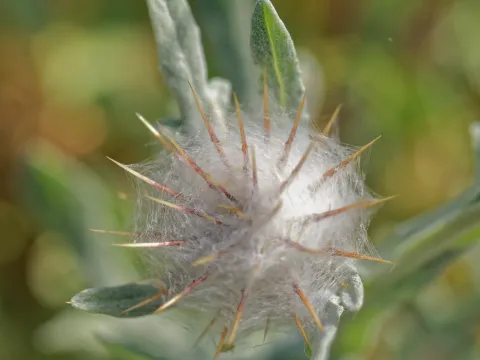
Woolly-headed star-thistle
Centaurea eriophora
Woolly-headed star-thistle (Centaurea eriophora) belongs to the Asteraceae family. In agricultural settings, sowing is typically carried out in the spring, once soil temperatures reach 10-12 degrees Celsius to ensure uniform germination.
What the section contains
Woolly-headed star-thistle
The seeds require pre-sowing preparation, including stratification, to improve germination vigor. An optimal sowing depth of 1-2 centimeters is recommended to ensure the seeds have sufficient contact with the moisture-retaining soil layers.
For large-scale cultivation, drilling is the preferred method, with row spacing maintained at 40-45 centimeters. This spacing facilitates easier weed control and allows for optimal light penetration for the developing plants.
As an annual plant, it completes its full life cycle within a single growing season. Uniform distribution of seeds is essential for establishing a dense and healthy crop canopy, preventing gaps where weeds could thrive.
Selection of the site is critical; the plant requires open, sunny locations with minimal shading. Planting should follow a cereal-based crop rotation cycle to avoid the accumulation of soil-borne pathogens common to this family.
Native to the Mediterranean region, this species is well-adapted to arid and semi-arid conditions, exhibiting excellent drought resistance. It performs best in regions where high solar radiation coincides with the growing period.
The plant is not highly demanding regarding soil fertility but requires well-drained soil. Sandy or light loamy soils are ideal, as the plant is highly susceptible to root damage caused by waterlogging.
Soil pH should ideally be within the neutral to slightly alkaline range (6.5-7.5). If the soil is acidic, liming is a necessary pre-sowing measure to ensure proper nutrient availability for the plant's development.
Fertilization should be balanced, focusing on phosphorus and potassium to strengthen structural integrity. Excess nitrogen should be avoided, as it encourages excessive vegetative growth at the expense of floral development.
The plant features distinct spiny involucral bracts, an evolutionary adaptation that protects the seeds and allows the plant to thrive in challenging environments with high animal pressure.
The primary use of Centaurea eriophora is the production of medicinal plant material. The yield is measured by the quantity and quality of flower heads harvested during the peak blooming stage.
Proper management, including timely weeding and moisture monitoring, directly influences the final yield. Harvesting occurs when the active compounds in the florets are at their highest concentration.
Beyond its medicinal value, this plant serves as a significant honey plant. Beekeepers utilize it to provide a unique nectar source that can enhance the quality and flavor profile of artisanal honey.
In industry, extracts from the plant are explored for use in cosmetic formulations due to their antioxidant properties. This has created a small but steady market demand for sustainably grown crops.
Productivity is highly dependent on the timing of the harvest. If delayed, the seeds may begin to disperse due to their adaptation for wind and animal transport, leading to significant crop losses.
Powdery mildew is a common fungal threat, especially in humid conditions or where there is poor air circulation around the crop. Fungicidal treatments may be necessary if early signs of infection are detected.
Root rots can become problematic if irrigation management is poor. Ensuring that the soil structure is friable and that drainage is efficient is the primary defense against these pathogens.
Pests such as aphids and various true bugs can damage the developing flower heads, which directly reduces the market value of the crop. Monitoring for these pests is essential during the budding phase.
Weed competition is significant during the early seedling stages. Because the plant has a slow initial growth rate, mechanical or manual cultivation of the rows is necessary to prevent weeds from overpowering the crop.
Integrated pest management (IPM) is encouraged to maintain crop health. Using biological controls for aphid populations helps protect the delicate balance of the field ecosystem while ensuring a residue-free harvest.
Harvesting is conducted manually or with specialized machinery during the morning hours, once the dew has evaporated. This preserves the essential oils and active ingredients within the flowers.
Drying must occur immediately after harvest. Using climate-controlled drying facilities at temperatures not exceeding 45 degrees Celsius ensures that the pharmacological properties of the plant material are preserved.
For seed production, harvesting must be timed with the browning of the bracts. Handling the crop requires protective equipment due to the sharp spines that characterize the flower heads.
Processing involves cleaning the heads to remove inert matter and debris. Modern sieving equipment is highly effective at separating high-quality seeds from the unwanted, spiny involucral parts.
Final storage requires moisture-proof containers in a cool, ventilated area. This maintains the viability of the seeds and prevents degradation of the herbal components until they reach the final consumer.