
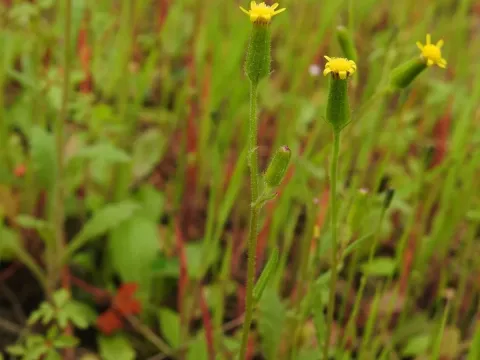
Lead-colored groundsel
Senecio lividus
Lead-colored groundsel (Senecio lividus) is an annual herbaceous plant belonging to the Asteraceae family. In agronomy, it is primarily categorized as an invasive weed that competes with crops for water and nutrients.
What the section contains
Lead-colored groundsel
The plant thrives in well-lit areas with light, porous soils. It is frequently observed in disturbed lands, field margins, and within arable land where crop competition is relatively low during the early growth stages.
Botanically, it is defined by its distinct glaucous or greyish foliage, which provides a level of protection against intense sunlight and minor water deficits. The plant typically reaches a height of 40 to 80 centimeters.
Climate requirements include temperate conditions with sufficient light for germination. It is highly adaptable to various soil pH levels, provided the soil is not excessively compacted or permanently waterlogged.
Its life cycle is optimized for rapid colonization. The production of numerous wind-dispersed seeds ensures its survival across diverse landscape mosaics, making it a persistent challenge for modern field management.
Typical threats include various sap-sucking insects, particularly aphids, which can significantly stunt the growth of young plants. Monitoring of such pests is essential to prevent rapid spread across agricultural plots.
Fungal pathogens such as powdery mildew represent a major threat to the plant's health during humid seasons. These infections reduce the plant's ability to compete with neighboring crops by limiting photosynthetic efficiency.
Effective management relies on mechanical practices, such as deep plowing and timely cultivation. Interrupting the weed's life cycle before seed dispersal is critical for preventing population explosions in subsequent years.
Chemical control involving selective herbicides is a standard approach in industrial farming. Applications must be timed accurately according to the growth stage of the weed to maximize the efficiency of the active ingredients.
Integrated pest management strategies should focus on maintaining strong and healthy crop canopy cover. Dense stands of target crops serve as a natural inhibitor against the establishment and spread of this opportunistic weed species.