
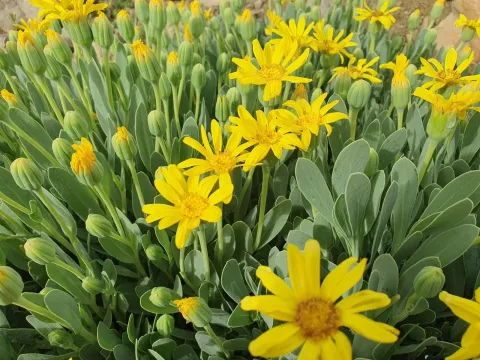
Hertia
Hertia
Hertia is primarily a wild-growing perennial subshrub belonging to the Asteraceae family. Since it is not a major agricultural crop in the conventional sense, strict sowing dates have not been standardized for large-scale production.
What the section contains


Hertia
When cultivated in specialized nurseries, seeds are typically sown in the spring once the soil temperature reaches 10–12°C, or during autumn in regions with mild winters.
The seeds should be planted at a depth of 1–2 centimeters, ensuring excellent soil-to-seed contact and maintaining adequate moisture for successful germination.
In its natural habitat, the plant propagates mainly via seeds, with its life cycle synchronized to the limited rainy seasons in African and Middle Eastern arid regions.
To enhance germination rates, seeds may require scarification or treatment with growth stimulants to overcome natural dormancy mechanisms.
Hertia is classified as a xerophyte, a plant species highly adapted to extremely arid environments and intense solar radiation.
The crop thrives in stony, sandy, or loamy soils with excellent drainage properties, as waterlogging is highly detrimental to its health.
Optimal soil pH for Hertia cultivation ranges from 6.5 to 7.5, reflecting its preference for near-neutral soil conditions.
The plant exhibits remarkable resilience to extreme diurnal temperature fluctuations, allowing it to survive and persist in harsh desert and semi-desert zones.
Maintenance involves minimal irrigation, as the root system is highly susceptible to rot if exposed to excess moisture for prolonged periods.
The primary threats to Hertia are fungal infections of the root system, which are generally triggered by over-irrigation or inadequate drainage.
Under controlled environments or greenhouse conditions, the plants may become targets for common pests like spider mites and aphids that feed on young shoots.
Locust infestations are a significant natural risk factor, as Hertia often grows in regions where these insects are highly prevalent.
Disease prevention strategies should focus on maintaining proper plant spacing to facilitate airflow and conducting regular scouting for signs of early infection.
Copper-based fungicides can be utilized to manage bacterial leaf spots, although application should be targeted and strictly limited to prevent chemical stress.