
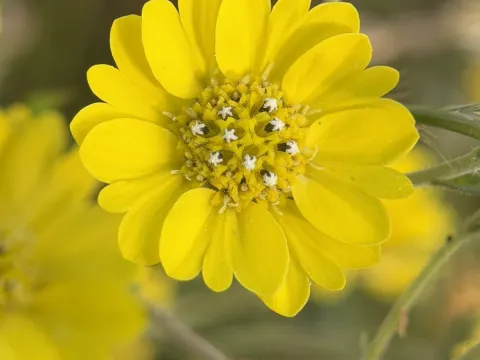
Hemizonia
Hemizonia
Hemizonia is a genus of annual herbaceous plants belonging to the Asteraceae family, native to western North America, particularly California. This crop is known for its potential as an oilseed source, offering a unique fatty acid profile in its seeds.
What the section contains
Hemizonia
The sowing period for Hemizonia occurs in early spring once the soil temperature reaches approximately 10-12 degrees Celsius. Ensuring adequate soil moisture during the germination phase is critical, making it necessary to plant shortly after the last frosts or snowmelt.
The planting technology involves the use of grain drills with a seed depth of 2-3 centimeters. Due to the small size of the seeds, achieving firm contact with the soil is essential for uniform emergence, which is typically managed by rolling the field post-seeding.
Seeding rates range from 6 to 10 kilograms per hectare depending on soil quality and the specific planting arrangement. Maintaining optimal plant density is vital to reduce competition for nutrients and solar energy, ultimately driving higher seed yields.
If producing seeds, maintaining spatial isolation is important as Hemizonia is prone to cross-pollination. Selecting fields that have not hosted other Asteraceae species recently is a best practice to mitigate common crop-specific risks.
The crop is relatively adaptable but performs best in light, well-drained sandy loam or loam soils. Maintaining a soil pH close to neutral is beneficial for maximizing nutrient uptake and ensuring the plant can thrive throughout the growth cycle.
Hemizonia exhibits high drought tolerance, making it an excellent candidate for regions experiencing hot, dry summers. Its deep root system allows the plant to tap into moisture reserves deeper within the soil profile, reducing reliance on irrigation.
Abundant solar radiation and stable, warm weather during the flowering and maturation stages are necessary for high oil accumulation in the seeds. High humidity during these phases may negatively impact health and promote fungal growth.
Early-season weed control is a critical aspect of Hemizonia agronomy because the plant exhibits slow growth during the initial weeks. Managing weed competition effectively during this phase is essential for establishing a healthy, high-yielding stand.
Balanced mineral nutrition, particularly with sufficient phosphorus and potassium, supports reproductive organ development. Excess nitrogen should be avoided to prevent over-abundant foliage growth at the expense of seed quality and overall yield.
Average seed yields for Hemizonia under favorable agronomic conditions range between 10 and 15 quintals per hectare. Results may vary significantly based on precipitation patterns and management practices during critical growth periods.
The oil content in Hemizonia seeds ranges from 25 to 40 percent, positioning it as a potentially valuable specialty oilseed crop. The oil possesses characteristics suitable for various technical and, in some cases, industrial applications.
Yield stability depends on achieving uniform emergence and maintaining a stress-free environment for the plants. Strict adherence to management protocols allows farmers to realize the maximum biological potential of the crop variety.
Productivity is closely linked to seed quality and the use of modern cultivars that demonstrate high germination energy. Properly timed field operations ensure that the plants are not subjected to preventable physiological stresses.
Regular field scouting allows producers to adjust cultivation plans dynamically, preventing yield losses from premature seed shedding or adverse climatic impacts during the maturation phase.
Common diseases affecting Hemizonia include powdery mildew, which tends to develop in conditions of high humidity and moderate temperatures. Preventive strategies focus on crop rotation and ensuring appropriate plant spacing to improve air circulation.
Pests, particularly aphids, can cause significant damage by feeding on plant sap. Beyond direct mechanical injury, aphids are vectors for various viral diseases that can stunt plant growth and reduce overall seed productivity.
Plant bugs may feed on developing flower heads and seeds, leading to lower seed weight and quality. Targeted insecticide applications during periods of high pest activity are often necessary to protect the harvest from severe economic damage.
Root rot issues may arise in poorly drained or compacted soils. Selecting sites with good natural drainage and maintaining healthy soil structure are the primary preventive measures against soil-borne pathogens.
Weeds represent a severe threat to Hemizonia, especially in the early stages of the season. Effective weed management is necessary to avoid significant reductions in growth vigor and total crop yields caused by resource competition.
Harvesting Hemizonia is typically conducted using direct combine harvesting when seeds reach full maturity. Monitoring moisture levels is crucial; harvesting at 12-14 percent moisture helps minimize losses due to natural seed shattering.
Utilizing specialized headers and optimizing combine settings is essential to reduce vibrations and mechanical damage. Careful adjustment of the threshing drum helps preserve seed integrity and quality during the harvesting process.
Post-harvest processing requires immediate cleaning and drying to reach safe storage moisture levels. Effective cleaning ensures that the crop remains stable and prevents self-heating in storage bins.
Storage should take place in dry, well-ventilated facilities with temperature control. When stored properly, Hemizonia seeds retain their viability and oil quality for extended periods, preserving the value of the harvested produce.
Efficient logistics during the harvest window are vital to prevent downtime and potential weather-related losses. Timely harvesting is one of the most important factors in achieving a high-quality marketable seed product.