
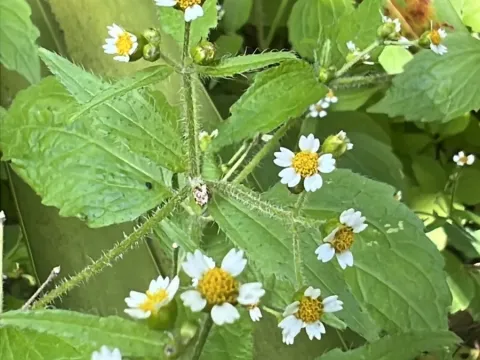
Shaggy soldier
Galinsoga quadriradiata
The shaggy soldier (Galinsoga quadriradiata) is an annual herb belonging to the Asteraceae family. Originating from South America, this plant has become a globally recognized invasive species that frequently infests various agricultural settings.
What the section contains
Shaggy soldier
This weed thrives in moist, nitrogen-rich, and well-drained soils. It is frequently observed in gardens, agricultural fields, and disturbed open areas where competition from native species is minimal.
The species is characterized by rapid growth and development. It is highly responsive to high temperatures and abundant moisture, allowing it to complete its reproductive cycle in a very short period of time compared to many other annual weeds.
Shaggy soldier has a remarkably high seed output, with a single plant capable of producing hundreds of thousands of seeds. These seeds remain viable in the soil for several years, creating a persistent seed bank that challenges long-term weed control efforts.
Botanically, it features branched stems that can root at the lower nodes when in contact with moist soil, allowing it to survive mechanical disturbance and continue to spread even after initial cultivation attempts.
As an agricultural weed, the shaggy soldier is highly competitive for water and soil nutrients. In dense infestations, it can significantly reduce the yield of commercial crops like potatoes, tomatoes, and various legumes.
The plant acts as an alternative host for several pests, including aphids. By harboring these insects, the weed facilitates the transmission of various plant viruses that are economically damaging to vegetable production.
Pathogen studies indicate that this weed can harbor fungal pathogens that cause wilting and root diseases in surrounding crops, making it a priority for field sanitation and disease management.
Integrated weed management is essential for controlling this species. Farmers typically employ crop rotation, mulching, and the use of targeted herbicides to suppress populations during the early growth stages.
Effective control requires timely intervention; the goal must be to destroy the plants before they reach the flowering stage, preventing the massive dispersal of seeds that would otherwise guarantee re-infestation in subsequent years.