
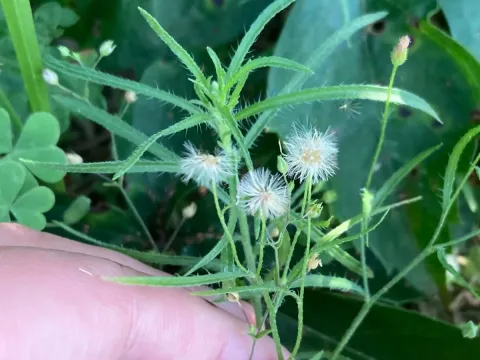
Spreading fleabane
Erigeron divaricatus
Spreading fleabane (Erigeron divaricatus) is an annual herbaceous plant belonging to the Asteraceae family. While not a cultivated crop, it is a significant weed that colonizes agricultural fields, often competing with crops for resources.
What the section contains
Spreading fleabane
Native to North America, this species has successfully spread to various temperate regions globally. It typically establishes itself in disturbed soils, including abandoned fields, pastures, and along rural roadsides.
Botanically, the plant is characterized by a widely branched stem, which gives it a distinct appearance. Its leaves are linear to lanceolate, and it produces numerous small flower heads containing both ray and disk florets.
It thrives in well-drained, sandy, or disturbed soils and has a strong preference for full sun exposure. The plant's ability to withstand drought makes it a hardy competitor in fields where irrigation or moisture is limited.
Management practices for this species include mechanical control methods like harrowing or plowing, which are effective in killing young seedlings before they develop a deep root system. Maintaining clean field margins is essential to prevent seed dispersal.
As a weed, Spreading fleabane poses a threat by extracting nutrients and water that should otherwise be reserved for crops. Its fast growth rate allows it to quickly overwhelm early-stage seedlings of cultivated plants.
The plant acts as a reservoir for several insect pests, specifically aphids, which are vectors for various plant viruses. This relationship poses a constant indirect threat to nearby commercial vegetable or field crop production.
Fungal diseases such as powdery mildew commonly affect the plant, especially in high-humidity seasons, potentially spreading to susceptible crop species in the immediate vicinity.
Among the pests, various species of leaf-chewing insects can be found on the foliage. While usually not fatal to the weed, these pests can migrate to crops after the fleabane is removed or wilts.
Agricultural control requires a combination of herbicides and tillage. In conventional farming, selective herbicides applied during the rosette stage of the weed are the most effective way to eliminate infestations before the flowering cycle begins.