
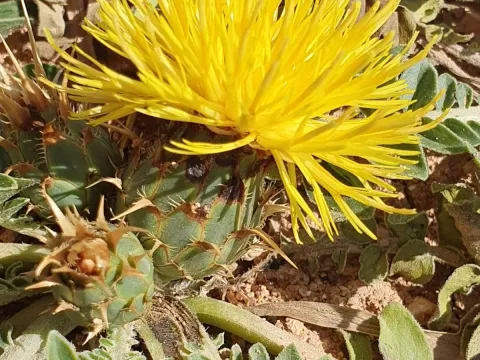
Stemless knapweed
Centaurea acaulis
Stemless knapweed (Centaurea acaulis) is a distinctive member of the Asteraceae family. Native to North Africa and Mediterranean mountain regions, it is uniquely adapted to thrive in harsh, rocky environments.
What the section contains
Stemless knapweed
The plant exhibits a rosette growth pattern with virtually no aerial stem, keeping its foliage close to the ground. This architectural feature protects it from strong mountain winds and intense thermal fluctuations.
Regarding soil requirements, it necessitates extremely well-drained, porous ground. It prefers poor, stony soils with a slightly alkaline or neutral pH, mimicking its natural mountainous habitat.
Sunlight is the primary prerequisite for cultivation, as it requires full exposure to thrive. Shade will result in sparse development and a significant loss of its natural compact aesthetic form.
The main horticultural use for this species is in rock gardens or xeriscaping projects, where its drought resistance and unique bloom structure provide high visual interest with minimal maintenance.
The primary threats include fungal pathogens such as root rot and powdery mildew, which flourish primarily when the root zone remains waterlogged for extended periods.
Pest pressures are generally manageable but can include aphids and various leaf-chewing larvae that target the dense foliage of the rosette during the peak growing season.
Good air circulation is essential for disease prevention; therefore, spacing between individual plants should be carefully managed to avoid creating humid microclimates.
Chemical control should be approached with caution, as the plant is not adapted to high levels of synthetic fertilizers or harsh systemic pesticides that might stress the plant roots.
Regular monitoring for soil-borne pests is advised, as the taproot is sensitive and can be severely compromised by larvae that burrow into the soil near the base.