
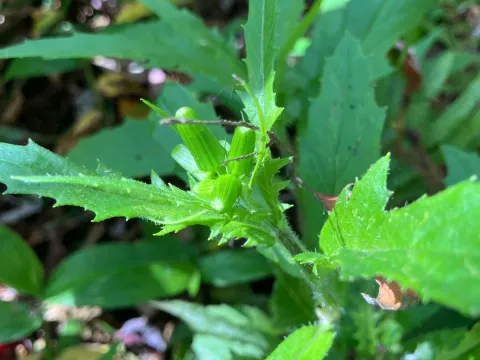
American burnweed
Erechtites hieracifolia
Erechtites hieracifolius, commonly known as American burnweed, is an annual herbaceous plant belonging to the Asteraceae family. It is highly prolific, producing large quantities of seeds equipped with pappus, which allows them to travel long distances through wind dispersal.
What the section contains
American burnweed
Germination typically begins in early spring once soil temperatures reach approximately 10 to 12 degrees Celsius. Seeds are light-dependent, requiring exposure to sunlight for successful germination, which dictates a shallow planting depth of no more than 1 centimeter.
In agricultural settings, the plant often appears in disturbed soil, such as recently cultivated fields or areas cleared by fire, from which its name "burnweed" is derived. Rapid establishment allows it to quickly colonize gaps in the crop canopy.
To manage its growth, early-season cultivation is necessary to disrupt the germination of the seed bank in the topsoil. Repeated tillage before the flowering stage is the most effective way to prevent the establishment of dense populations in commercial fields.
Successful sowing for research or medicinal purposes requires precise placement in moist, well-aerated soil. Ensuring optimal spacing between plants helps maximize the leaf biomass production, which is the primary goal for cultivation of this species.
American burnweed thrives in a variety of soil types, ranging from sandy loams to heavier clays, provided there is adequate drainage. It prefers soils rich in nitrogen and organic matter, which stimulate rapid vegetative development during the summer months.
This plant is strictly heliophilic, meaning it requires full sun exposure to reach its physiological potential. In shaded conditions, the plant fails to develop properly, resulting in thin, etiolated stems and significantly lower biomass accumulation.
Water requirements are moderate, though the species performs best with consistent moisture levels throughout the growing season. While it is somewhat drought-tolerant, prolonged water stress will inhibit leaf expansion and reduce the overall yield of the crop.
Temperatures between 20 and 25 degrees Celsius are ideal for growth. As an annual, it is sensitive to frost, which signals the end of its life cycle; therefore, its cultivation cycle is strictly limited to the frost-free period of the year.
Soil structure should be maintained through regular aeration. Given its natural affinity for disturbed sites, American burnweed benefits from minimal soil compaction, which allows its roots to penetrate deeper and acquire nutrients more efficiently.
The economic value of American burnweed is largely tied to its medicinal properties, as the leaves contain various bioactive compounds including flavonoids and volatile oils. Harvesting for research or industrial use focuses on maximizing this leaf biomass.
Yield potentials can be significant under optimized conditions, with intensive management often yielding substantial amounts of fresh green matter per hectare. Nitrogen supplementation is usually the primary factor in driving higher yields for this specific crop.
Timing the harvest is critical because the biochemical profile of the plant changes rapidly upon the initiation of reproductive growth. Once flowers begin to form, the leaves often lose some of their potency, making pre-flowering the optimal harvest window.
Post-harvest processing involves stripping the leaves from the stalks and drying them under controlled conditions. This prevents the loss of volatile compounds and maintains the quality of the raw material for secondary processing applications.
Efficient harvesting techniques involve mechanical cutting at a height that avoids contaminating the yield with soil or root matter. This clean harvesting approach is essential for maintaining high pharmaceutical-grade standards in the harvested product.
American burnweed is relatively hardy, but it can be susceptible to various fungal pathogens when grown in high-density environments. Conditions such as high humidity and lack of air circulation often lead to outbreaks of powdery mildew.
Root rots may occur if the soil remains waterlogged for extended periods. These pathogens attack the root system, leading to rapid wilting and necrosis of the plant tissue, which can devastate the entire population if left untreated.
Pests like aphids are common threats, especially during dry spells when they tend to congregate on the succulent terminal shoots. Regular scouting allows for early detection, enabling farmers to apply corrective measures before the infestation becomes severe.
Disease management relies heavily on preventative cultural practices, such as wide spacing and proper irrigation scheduling to keep the foliage dry. Rotating fields every season is also recommended to prevent the build-up of soil-borne pathogens.
Biological control agents and organic insecticides can be used to manage localized pest issues. Maintaining a healthy soil microbiome often provides enough natural resistance to protect the crop from the most common environmental pathogens.
The harvest phase for American burnweed is timed based on the vegetative development stage. The crop is typically cut when the plant is at its maximum vegetative size, usually just before the appearance of the first flower buds.
Mechanical mowers adjusted to a specific cutting height allow for clean, efficient harvesting. It is important to leave enough of the stalk intact if re-growth is desired, though for medicinal harvests, total removal of the primary biomass is standard.
Transport logistics require well-ventilated crates to prevent heat build-up within the harvested biomass. If left in large, unventilated piles, the green matter can start to ferment or rot, ruining the quality of the extracted oils.
Sorting after the harvest is essential to remove any weeds or debris that might have been picked up during the cutting process. This quality control step ensures that the final product meets the standards required for downstream extraction or processing.
Long-term storage of the dried product requires low-humidity environments to prevent re-hydration and potential fungal growth. Keeping the dried material in cool, dark, and dry conditions preserves the integrity of the bioactive compounds for months.