
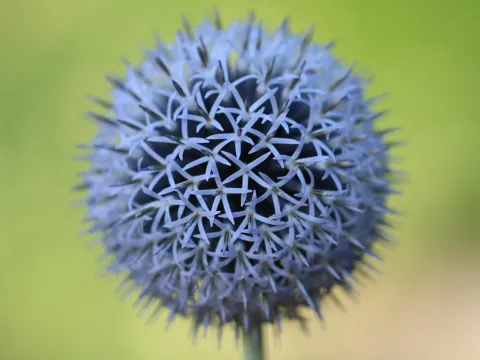
Echinops hybrids
Echinops hybrids
Sowing of Echinops hybrids is best performed in early spring as soon as the soil warms up to 5-8 degrees Celsius. Autumn sowing in late October is also a viable option, allowing for natural seed stratification and ensuring better germination rates in the spring.
What the section contains
Echinops hybrids
The seeding rate is approximately 8–10 kg per hectare with a row spacing of 60–70 cm. This spacing provides enough room for the plants to establish a strong root system and a rosette of leaves during their first year of development.
Seeds should be planted at a depth of 2-3 cm. Ensuring good seed-to-soil contact is critical, so light rolling of the field after sowing is recommended to promote faster and more uniform emergence.
In the first year, Echinops hybrids focus on root growth and foliage development. During this stage, it is crucial to keep the field free of weeds to prevent competition for light and nutrients.
After the first true leaves appear, thinning should be carried out to leave 20-30 cm between plants. This prevents crowding and ensures that each plant has enough resources to bloom effectively in subsequent years.
Echinops hybrids belong to the Asteraceae family and are known for their exceptional drought tolerance. These plants thrive in open, sunny locations where they can receive maximum light exposure throughout the day.
The plant is not overly demanding regarding soil type but performs best in well-drained loamy or sandy soils. Waterlogged conditions are detrimental and should be avoided to prevent root rot and plant loss.
This crop is well-adapted to temperate climates, displaying excellent winter hardiness. Its deep taproot system allows it to survive harsh winters and extract water from lower soil levels during dry summer periods.
Agricultural maintenance is relatively simple, focusing on weed control in the first year and minimal tillage in the following years. Once established, the plant's dense foliage is quite effective at suppressing surrounding weeds.
Fertilization, particularly with phosphorus and potassium, can significantly enhance flower quality and nectar secretion, which is a major advantage for commercial honey production.
The primary economic value of Echinops hybrids is their high nectar production, which can reach 800 kg of honey per hectare. This makes them one of the most productive summer honey crops available.
The flowering period lasts for about 30 to 40 days, providing bees with a reliable and stable nectar source. The resulting honey has a distinct pleasant aroma and is slow to crystallize.
Seed yield is also quite significant, ranging from 500 to 700 kg per hectare. Collecting seeds on-site allows growers to expand their fields efficiently without the constant need for purchasing external seed supplies.
Beyond beekeeping, the plant has pharmaceutical applications. Its seeds contain the alkaloid echinopsine, which is utilized in medical preparations to stimulate the nervous system and treat muscular disorders.
Echinops also serves as an excellent soil improver. Its powerful root system breaks up compacted layers and adds organic matter to the soil profile, creating a better environment for subsequent crops.
Echinops hybrids are generally disease-resistant, but they may be susceptible to root rot in cases of excessive soil moisture. Proper field selection and drainage management are the best preventative measures.
Pest damage is usually minimal and rarely reaches economic damage thresholds. Occasional infestations of aphids or beetles can occur, but natural predator populations typically keep these in check without the need for chemical intervention.
Powdery mildew may occur at the end of the season under humid, fluctuating weather conditions. To minimize this, ensure proper plant spacing to maintain adequate airflow through the field.
The greatest threat to a new planting is competition from aggressive perennial weeds. Timely cultivation and weeding are essential during the establishment year to ensure the crop does not get choked out.
Avoid using systemic herbicides on adjacent fields, as they can drift and severely damage the Echinops plants, reducing their vitality and honey-producing capability.
Harvesting should occur when the flower heads turn a dull gray or brownish color and become brittle. It is important to harvest before the heads fully shatter to prevent significant seed loss in the field.
When using combine harvesters, the equipment must be calibrated for small seeds. If the weather is unpredictable, swathing the crop before threshing can help ensure uniform ripening and reduce losses.
After harvesting, seeds must be dried in a well-ventilated area until their moisture content drops to 12-14%. This prevents mold and degradation during long-term storage.
Cleaning should be conducted using specialized seed-cleaning machinery to remove chaff and debris. High-quality seed will maintain good germination potential for several years if stored in a cool, dry place.
The remaining plant biomass after seed collection can be shredded and incorporated back into the soil as organic matter, providing a nutrient boost to the field for future planting cycles.