
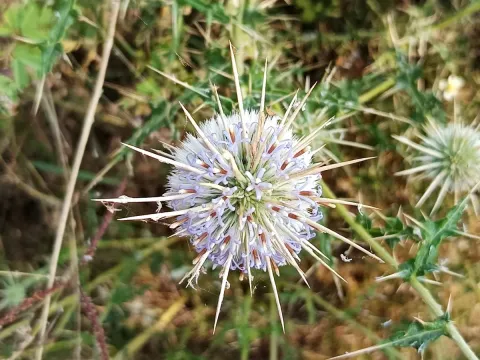
Echinops echinatus
Echinops echinatus
Echinops echinatus is a resilient perennial herb belonging to the Asteraceae family. Sowing is typically carried out in late autumn or early spring to allow for natural stratification, which is essential for uniform germination.
What the section contains
Echinops echinatus
Seeds should be planted at a shallow depth of approximately 1.5 to 2 centimeters. Proper seedbed preparation is vital, as the initial growth stage is slow and requires a weed-free environment.
For commercial cultivation, spacing between rows should be maintained at 45 to 60 centimeters. This layout allows for adequate air circulation and provides enough room for the development of the primary root system.
During the first year, the plant focuses on establishing a strong vegetative base in the form of a basal rosette. Therefore, intensive weeding is required during the first few weeks after emergence.
Target planting density is approximately 80,000 to 120,000 plants per hectare. Once established, the dense canopy helps the crop suppress competing vegetation, reducing the need for chemical intervention.
This species is highly photophilous and requires full sun exposure to thrive. Shade should be avoided as it significantly reduces both biomass production and the intensity of flowering.
Echinops echinatus is adaptable to various soil types but performs best in well-drained, sandy or loamy soils. It cannot tolerate waterlogging or high soil moisture levels, which can lead to root rot.
As a xerophytic plant, it demonstrates excellent drought tolerance. Once the deep taproot is established, the plant can sustain itself in arid conditions, making it suitable for marginal agricultural lands.
Fertilization should be managed carefully. Moderate applications of phosphorus and potassium support healthy development, while excessive nitrogen levels can be detrimental to the concentration of medicinal alkaloids.
The plant is highly adaptable to extreme temperature fluctuations. Its physiological structure allows it to withstand intense summer heat, which is a major advantage in regions prone to frequent heatwaves.
The economic value of Echinops echinatus lies in its dual-purpose utility: as a high-quality medicinal resource and an exceptional honey plant. Seed yields can reach 5–8 quintals per hectare.
As a nectar source, it is highly prized by beekeepers. The plant produces large volumes of nectar, making it a reliable honey source during late summer when other floral resources become scarce.
Honey production can reach up to 600–800 kg per hectare in optimal conditions. The combination of beekeeping and seed harvesting provides farmers with a diversified and stable income stream.
Medicinal roots are harvested from plants in their second or third year. With correct processing, the yield of dried root material can range from 15 to 20 quintals per hectare.
The pharmaceutical industry specifically values the seeds for their alkaloid content, which is used in the manufacturing of various therapeutic agents, ensuring a consistent market demand.
Echinops echinatus is naturally resistant to most common agricultural pests. Its sharp, spine-like structures serve as a physical deterrent against many herbivores and insects.
Disease incidence is generally very low. Potential risks are mostly associated with fungal pathogens that may appear in cases of soil compaction or extreme, prolonged humidity levels.
Preventive measures include ensuring proper spatial isolation and avoiding sites with high water tables. This keeps the environment dry enough to suppress the growth of detrimental mold or fungi.
Integrated Pest Management (IPM) practices should be followed if infestation occurs. Biological control agents are preferred over chemical pesticides to maintain the quality of the harvested produce.
Crop rotation remains the most effective strategy for long-term health. Avoid planting the species on the same field for at least 4 to 5 years to minimize the buildup of soil-borne pathogens.
Seed harvesting should be timed carefully when the flower heads turn brown but before they start shedding. Mechanical harvesters should be adjusted to prevent seed damage.
For high-quality medicinal material, flower heads should be gathered in the early morning to minimize natural seed shattering. Post-harvest drying must occur in a well-ventilated area.
The temperature during the drying process must be strictly monitored and should not exceed 40 degrees Celsius to preserve the structural integrity of the active pharmacological compounds.
Roots are harvested after the vegetative period is complete. They are washed thoroughly, cut into smaller pieces, and dried until they become brittle, which indicates the moisture level is optimal for storage.
Storage requires cool, dry, and dark conditions. Proper packaging in breathable containers ensures that the seeds and roots maintain their viability and chemical properties for several years.