
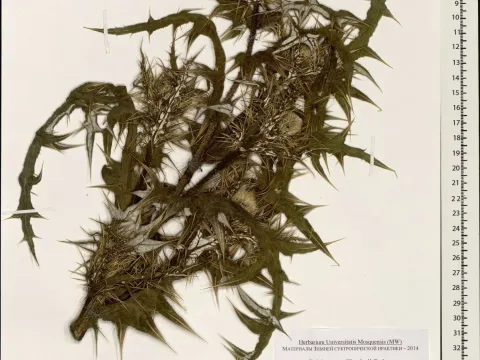
Echinops gaillardotii
Echinops gaillardotii
Echinops gaillardotii is a perennial herbaceous plant belonging to the Asteraceae family. In agricultural practice, it is recommended to sow seeds in early spring once soil temperatures reach 5–8 degrees Celsius or in late October for natural winter stratification.
What the section contains
Echinops gaillardotii
The seeds should be planted at a depth of 2–3 cm, ensuring good soil-to-seed contact. A well-prepared seedbed, free from perennial weeds and with a fine-crumb structure, is essential for successful germination.
The seeding rate for row cropping is approximately 8–10 kg per hectare. For honey production purposes, wide-row sowing with a spacing of 60–70 cm is preferred, as it allows for inter-row cultivation and optimal sunlight exposure.
During the first year, the plant focuses on developing its taproot system and a basal rosette of leaves. Robust vegetative growth and profuse flowering are typically observed starting from the second year and continue for 5–7 years.
This species possesses high ecological plasticity, allowing it to thrive in various climatic zones, specifically adapted to temperate continental conditions with moderate precipitation.
Echinops gaillardotii is a strictly heliophilic plant. It requires full sunlight exposure to maintain healthy growth and high nectar production levels, as shading significantly reduces its generative capacity.
The plant performs best on fertile chernozems, chestnut soils, or well-drained loamy soils with a neutral to slightly alkaline pH. It is highly adaptable to different soil types as long as drainage is sufficient.
Thanks to its deep taproot, the plant exhibits exceptional drought tolerance, making it an excellent candidate for marginal or eroded lands where other crops may struggle to survive.
The species is highly winter-hardy and capable of withstanding harsh temperature fluctuations. This durability makes it a reliable perennial choice for regions with significant climatic instability.
Waterlogging is detrimental to this crop. Therefore, it is critical to avoid low-lying fields or areas with high water tables, as stagnant water leads to root rot and poor crop performance.
The primary economic value of Echinops gaillardotii lies in its honey production. With proper management, it can yield between 500 and 1000 kg of high-quality honey per hectare annually.
Honey productivity is directly linked to stand density and soil fertility. Balanced mineral fertilization, particularly phosphorus and potassium, promotes the formation of larger flower heads and increased nectar secretion.
This plant is highly valued by apiarists because it continues to produce nectar even during dry periods when other major melliferous crops cease production, ensuring a steady food supply for bees.
In addition to nectar, the plant serves as a vital source of high-quality pollen, which is essential for healthy brood development in bee colonies during the mid-to-late summer period.
Its prolonged flowering phase, which can last up to 40–50 days, provides a continuous nectar flow, minimizing the need for supplemental feeding in commercial apiaries.
The crop is susceptible to common fungal pathogens, including powdery mildew and various rust diseases, which tend to proliferate under high humidity or in overcrowded planting conditions.
Insect pests, such as leaf beetles and weevils, may cause damage to the foliage and flower buds. Monitoring during the early growth and budding stages is crucial to prevent significant yield losses.
Root-feeding pests can pose a threat to young seedlings. Implementing proper crop rotation and soil preparation practices is essential to minimize the risk of infestation by soil-borne insects.
Preventive measures include maintaining appropriate plant spacing to improve airflow and timely removal of crop residues, which can act as a reservoir for pathogens.
Given the plant's role as a major nectar source, chemical pest control should be avoided or replaced with biological management strategies to ensure the safety of pollinating bees.
Seed harvesting should be performed when the flower heads reach full biological maturity, characterized by a greyish color and a brittle, dry texture.
Harvesting should be conducted during dry, sunny weather to prevent seed loss from shattering and to ensure the seeds can be stored without the risk of moisture-related spoilage.
After threshing, seeds must be cleaned and dried to a moisture content of no more than 10–12%. Properly dried seeds can maintain high germination viability for several years.
If the biomass is harvested for medicinal or fodder purposes, it should be cut at the peak of the mass flowering phase, before the stems become overly fibrous and seeds begin to form.
Timely harvesting is essential to prevent uncontrolled self-seeding, which can lead to excessive stand density and potentially impact the long-term productivity of the field.