
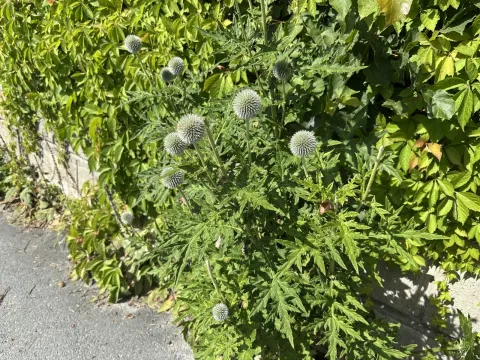
Echinops exaltatus
Echinops exaltatus
The sowing of Echinops exaltatus is typically carried out in late autumn or early spring, as soon as the soil is workable. Optimal timing for winter sowing occurs at the end of October.
What the section contains
Echinops exaltatus
For spring sowing, it is essential to ensure good seed-to-soil contact. The sowing depth usually ranges from 2 to 3 centimeters, allowing seedlings to emerge effectively.
For commercial plantations, a wide-row planting method with 60–70 centimeters between rows is practiced, which facilitates mechanized care and weed control during the first year.
Plant density must be managed to provide optimal light for each basal rosette, which is critical for the subsequent development of flower-bearing stems.
During the first year, the crop develops slowly, focusing on root establishment and rosette formation, necessitating careful weed management during this early stage.
Echinops exaltatus belongs to the Asteraceae family and is a perennial herbaceous plant adapted to temperate climates, known for its drought and frost resistance.
The crop thrives in well-lit areas, as shade significantly reduces nectar productivity. While it can tolerate temporary waterlogging, it performs best in well-drained loamy soils.
Soils should be fertile with a neutral to slightly alkaline pH. On poor sandy soils, development is delayed, often requiring the application of organic or mineral fertilizers.
The plant possesses a powerful root system, allowing it to efficiently absorb nutrients from deep soil layers, which minimizes the need for frequent irrigation.
In its natural habitat, it is found in forest clearings and steppe zones, which predetermines its resilience to wind and temperature fluctuations.
The primary economic value of Echinops exaltatus lies in its exceptional nectar productivity. Under favorable conditions, honey yields can reach up to 1000 kg per hectare.
The flowering period is extended, providing bees with a stable and consistent nectar source for several weeks during mid-summer.
Seed productivity is also high, allowing growers to use their own seeds to expand planting areas in subsequent seasons.
With proper management, a plantation can remain productive for 5–7 years before requiring rejuvenation or replanting.
The honey produced is highly regarded for its unique flavor profile and slow crystallization, making it a valuable product for apiaries.
The crop is generally resistant to typical agricultural diseases, though high humidity can occasionally lead to powdery mildew outbreaks.
Among pests, various species of weevils represent the greatest threat as they damage flower heads and significantly reduce seed yields.
In dense stands, aphid infestations may occur, which sap moisture from young shoots and weaken the plant during the budding stage.
Root rot may appear in heavy, waterlogged soils if proper drainage is not maintained within the field.
Preventive measures include crop rotation and timely weed control, as weeds can act as reservoirs for various pathogens.
Seed harvesting is conducted during the period of full biological maturity, when the seed heads appear dry and turn brown. Timing is crucial as seeds shatter easily.
Harvesting is usually performed mechanically using combines adjusted to minimize seed damage and loss.
Post-harvest, the material requires immediate cleaning and drying, as high seed moisture content leads to rapid loss of viability during storage.
To preserve seed quality, they should be stored in dry, well-ventilated areas using paper or cloth bags.
Crop residues can be incorporated into the soil as organic matter, helping to improve soil structure for future crops.