
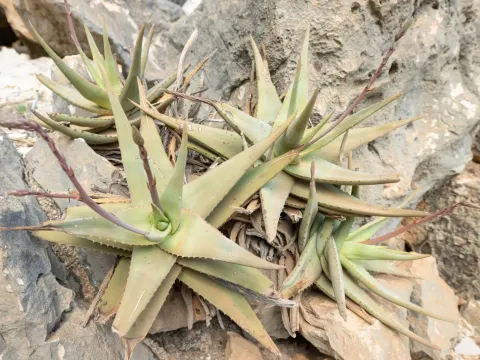
Aloe perryi
Aloe perryi
Aloe perryi, a prominent succulent belonging to the Asphodelaceae family, is endemic to the island of Socotra, Yemen. This plant thrives in arid, rocky environments and steep mountain slopes, perfectly adapted to extreme survival conditions.
What the section contains
Aloe perryi
The cultivation of this species requires well-draining, sandy, or rocky soil. Because the plant is highly susceptible to root rot, the medium must possess excellent porosity to prevent any accumulation of water around the root ball.
Climate requirements for Aloe perryi are strict: it demands intense sunlight and high temperatures throughout the year. It cannot survive in freezing conditions, making greenhouse cultivation mandatory in temperate regions.
Agricultural practices involve careful watering regimes; the soil must be allowed to dry out completely before the next irrigation cycle. Propagation is typically achieved through seeds or by dividing the offset shoots that grow at the base of the plant.
Industrially, Aloe perryi is primarily cultivated for the production of Socotrine aloe, a resinous extract derived from the leaves. This product is valued for its pharmacological applications, including digestive support and topical wound care.
The most significant threat to Aloe perryi is the development of fungal infections, particularly root and crown rot, which are triggered by improper watering techniques or high humidity levels.
Pests such as mealybugs and spider mites represent a constant challenge in industrial cultivation, as they can quickly colonize the succulent leaves, causing structural damage and reducing yield.
Integrated pest management is essential, emphasizing the use of quarantine for new plants and the application of targeted insecticides only when strictly necessary.
Ensuring proper ventilation and air circulation is the most effective preventative measure against both bacterial pathogens and soft-bodied insect pests.
Regular monitoring of leaf color and firmness allows agronomists to identify early signs of stress or infestation before they compromise the health of the entire crop.
The harvesting process involves carefully removing mature leaves from the outer layers of the rosette, ensuring the central meristem remains intact for continued growth.
Once harvested, the leaves are positioned to facilitate the drainage of the yellow, bitter latex, which is collected in sanitized vessels for further processing.
After collection, the raw exudate is subjected to evaporation to create the final commercial product, a solid form of aloe that is highly stable for storage and transport.
Harvesting efficiency depends on the maturity of the plant, with agronomists ensuring that only specimens of sufficient age are processed to maintain high quality of active chemical compounds.
Sanitation during the harvest is paramount, as the collected raw material is highly sensitive to contamination that could alter its chemical integrity and therapeutic efficacy.