
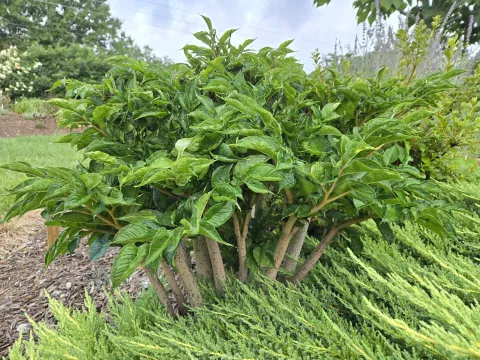
Amorphophallus
Amorphophallus hybrids
Amorphophallus is a perennial tuberous plant belonging to the Araceae family. Modern agriculture focuses on hybrid varieties optimized for growth and high glucomannan content.
What the section contains
Amorphophallus
Planting is carried out in early spring once soil temperatures consistently exceed 15 degrees Celsius. It is crucial to select firm, disease-free corms for planting to ensure a uniform crop stand.
The planting depth should range from 5 to 15 cm depending on the size of the corm. Maintaining appropriate spacing is essential to allow the plant to produce its large, single, complex leaf effectively.
Amorphophallus undergoes a distinct dormant period during which the aerial part of the plant completely dies back. Managing corms during this rest phase is critical for successful spring regrowth.
During the growing season, the plant develops a single large leaf that acts as the primary photosynthetic organ, accumulating energy stores in the corm for the subsequent cycle.
The crop requires loose, fertile, and well-drained soil. Avoid heavy or waterlogged soils, as these conditions rapidly lead to root and corm rot, causing significant crop loss.
Amorphophallus thrives in partial shade. Direct, intense sunlight can scorch the foliage, while complete darkness prevents the accumulation of necessary carbohydrate reserves.
Optimal growth temperatures range from 20 to 30 degrees Celsius. High humidity levels are beneficial for faster development of the vegetative mass and overall corm expansion.
Fertilization with balanced NPK formulas, emphasizing potassium, is recommended during the peak growth phase to improve corm maturation and storage potential.
Crop rotation is an essential agronomic practice to prevent the build-up of soil-borne pathogens, particularly those affecting the Araceae family.
The economic value of Amorphophallus is primarily driven by the extraction of glucomannan, a polysaccharide used extensively in the food industry as a thickener and dietary fiber.
Yield depends heavily on the age of the corm and the intensity of the agronomic practices applied. Properly managed corms can grow to substantial sizes over several years.
Industrial processing involves washing, slicing, drying, and milling the corms into a fine powder. Efficiency in post-harvest processing is key to maintaining product quality.
Higher yields are achieved through consistent moisture management and the prevention of vegetative damage during the active growing season.
Productivity is monitored through the weight increase of individual corms between the dormant cycles, allowing for precise planning of harvest schedules.
Fungal infections, often triggered by excessive soil moisture, represent the most significant threat to this crop. These pathogens can cause rapid degradation of corm tissues.
Common pests include spider mites and thrips, which damage the foliage and reduce the plant's photosynthetic capacity, ultimately hindering corm growth.
Mechanical damage during harvest creates entry points for bacteria, leading to soft rot. Careful handling during and after harvest is mandatory to ensure storage longevity.
Storage-related diseases are prevalent if corms are not sufficiently cured or if they are stored in environments with inadequate ventilation and improper humidity.
- Fusarium root rot
- Bacterial soft rot
- Spider mites
- Root mealybugs
Harvesting takes place once the foliage has completely withered and turned yellow, signaling that the plant has finished translocating nutrients into the corm.
Care must be taken to extract the corms without causing mechanical abrasions. The use of appropriate harvesting equipment is necessary for large-scale operations.
Following harvest, corms should be cleaned and cured in a shaded, well-ventilated area for several days to allow any minor wounds to heal naturally.
Corms intended for long-term storage must be kept in a cool, dry environment with good air circulation to maintain dormancy and prevent fungal outbreaks.
Grading by size and health status should be performed immediately post-harvest to separate processing-ready produce from healthy planting stock for the following year.