
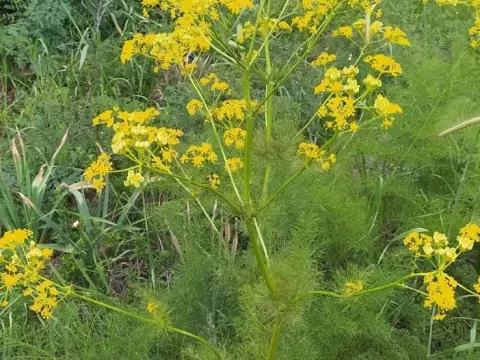
Prangos
Prangos
Prangos is a perennial herb belonging to the Apiaceae family. In natural conditions, seeds typically germinate after a cold period, requiring stratification to break dormancy. Sowing usually occurs in autumn or early spring.
What the section contains


Prangos
For commercial cultivation, scarification is often recommended to improve germination rates. Seeds should be sown at a depth of 2–3 centimeters in well-prepared, loose soil to facilitate proper root development.
The plant exhibits slow initial growth, spending the first year forming a basal rosette of leaves. Robust stem development and flowering typically begin from the second or third year onwards.
Spacing is crucial for Prangos due to its massive canopy at maturity. A row spacing of 45 to 60 centimeters is generally advised to ensure optimal resource allocation and easier weed management.
Using high-quality, viable seeds is essential for establishing a uniform stand. Careful attention to sowing density and soil moisture during the establishment phase ensures better survival rates of the crop.
Prangos is highly valued for its drought resistance and tolerance to high temperatures, making it well-suited for semi-arid environments and mountainous regions in Central Asia and the Caucasus.
The crop thrives in well-drained soils, ranging from sandy loams to light clays. It is sensitive to waterlogging, as excessive moisture in the root zone can lead to rot and plant mortality.
Being a heliophilic plant, Prangos requires full sun exposure to reach its full potential. Shade significantly inhibits growth, leading to reduced biomass production and diminished feed value.
The deep-reaching taproot system of Prangos allows the plant to access deep soil moisture, making it a valuable species for pasture restoration and soil stabilization in arid areas.
Agronomic management primarily focuses on initial weed control. Once established, the plants are highly competitive and require minimal maintenance, making them ideal for extensive farming systems.
The primary use of Prangos is as a high-quality forage crop. It remains nutritious even when dried, as it retains high levels of protein and essential minerals throughout the growing season.
Biomass yield is influenced by environmental factors and the maturity of the plants. In productive years, it provides multiple cuts, offering a reliable feed source during dry periods when other grasses fail.
It is palatable and nutritious for various types of livestock, including sheep, goats, and cattle. Incorporating Prangos into pastoral systems can significantly improve the productivity of livestock operations.
Its ability to provide green fodder during the hot, dry season makes it a critical component of the "green conveyor" system in steppe and semi-desert farming regions.
Beyond its forage value, some Prangos species are being studied for their chemical profile, including the presence of coumarins and essential oils, which offer potential in the pharmaceutical industry.
The main biological threats to Prangos include fungal diseases that flourish under conditions of high humidity, such as powdery mildew, which can significantly damage leaf tissues.
Insect pests, including umbrella moths and various bug species, can severely impact reproductive organs, leading to significant yield losses in seed production areas.
Root rot is a major risk, especially when the crop is planted in heavy, poorly aerated soils where water accumulation occurs. Improving drainage is the best preventative strategy.
Effective management involves maintaining healthy crop rotations and removing crop debris post-harvest to reduce the buildup of pathogens and pest populations in the field.
Constant monitoring of the field, especially during the budding and flowering phases, is vital for timely detection and management of infestations to maintain crop health.
Harvesting for hay should be performed at the start of the flowering phase, when the nutrient content is at its peak. Delaying the harvest results in the lignification of stems, reducing digestibility.
Standard hay-making machinery is used for cutting. The harvested material dries relatively quickly, preserving the nutritional profile, which makes it an excellent choice for winter fodder storage.
For seed collection, the harvest must take place when the fruits reach full maturity but before they begin to shatter, as the seeds are prone to shedding easily once dry.
Post-harvest residues can be used as a source of roughage for animals. However, producers should monitor the intake to ensure it meets the nutritional requirements of the specific livestock category.
Proper storage in dry, well-ventilated areas is required to maintain the quality of the harvested biomass over long periods, ensuring that the forage remains safe and nutritious for animals.