
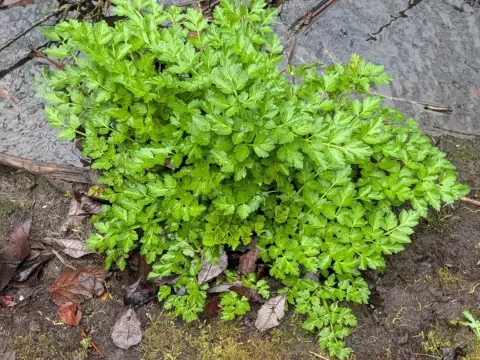
Hemlock water dropwort
Oenanthe crocata
Oenanthe crocata, commonly known as hemlock water dropwort, is a perennial plant belonging to the Apiaceae family. It is notorious for its resemblance to edible plants like wild celery, leading to severe poisoning risks.
What the section contains
Hemlock water dropwort
The plant originates from Western Europe and the Mediterranean basin. Its natural habitat includes marshes, stream banks, and damp meadows where the soil remains consistently waterlogged throughout the growing season.
Botanically, it features thick, tuberous roots that resemble a bunch of parsnips. The stems are hollow, robust, and can grow up to 1.5 meters tall, supporting umbels of small white flowers that bloom in early summer.
The foliage is dark green and tripinnate, similar in appearance to parsley. When the stem or root is cut, a characteristic yellow-orange sap is released, which rapidly darkens upon exposure to oxygen.
It thrives in nutrient-rich, heavy soils that possess high moisture retention capabilities. It is strictly a hydrophyte-adjacent species, requiring environmental conditions that prevent root desiccation.
Hemlock water dropwort is considered one of the most poisonous plants in its native range. It contains polyacetylenes, specifically oenanthotoxin, which cause violent convulsions and cardiac/respiratory failure if ingested.
In agricultural settings, it is a dangerous weed for livestock. Grazing animals, particularly cattle, may ingest the roots when they are exposed during ditch cleaning or land reclamation, often with fatal results.
There are no known significant agricultural diseases that plague Oenanthe crocata, as its own chemical defenses provide it with an almost impenetrable barrier against bacterial and fungal infections.
Pest pressure is minimal. While some specialized insects may feed on the leaves, the plant's potent toxicity renders it unappealing to most generalist herbivores, both vertebrate and invertebrate.
Management requires rigorous physical removal. Because the tubers are highly toxic and persistent, any attempt to clear an area must ensure the complete removal of the entire root system to prevent regrowth.