
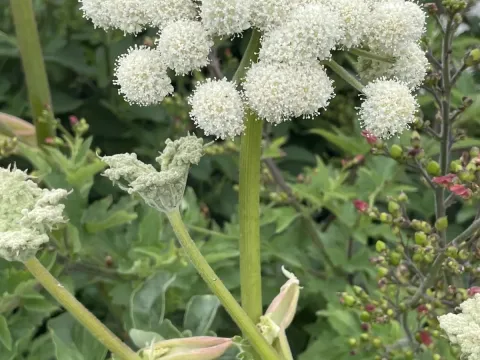
Henderson's Angelica
Angelica hendersonii
Sowing Angelica hendersonii seeds is best performed during late autumn to allow for natural stratification, which is essential for breaking seed dormancy.
What the section contains
Henderson's Angelica
If opting for spring planting, ensure the seeds undergo cold stratification for at least 6-8 weeks in a damp medium to guarantee consistent germination.
Seeds should be covered with a light layer of soil, no more than 1 cm deep, as they require a certain level of moisture and surface contact to sprout.
The spacing between rows should be maintained at roughly 60 cm to allow for adequate ventilation and to facilitate mechanical or manual weeding operations.
Propagation through seedlings is a viable alternative for controlled environments, requiring pots with well-draining soil mix kept at moderate temperatures.
Henderson's Angelica is a robust herbaceous perennial belonging to the Apiaceae family, native to coastal environments and moist habitats of North America.
This crop thrives in deep, humus-rich, and moisture-retentive soils, making it an excellent choice for sites with high organic matter content.
While the plant can adapt to various conditions, it performs optimally in partial shade settings where soil moisture levels remain consistent throughout the day.
Soil structure should be friable and well-aerated to support the development of its large taproot, which acts as a primary nutrient storage organ.
It prefers a neutral to slightly acidic pH, which optimizes the bioavailability of essential minerals required for vigorous leaf and stalk production.
Common pests affecting this crop include aphids, which often colonize the underside of leaves and tender stems, potentially causing significant stunted growth.
Powdery mildew represents a major fungal threat, particularly in regions with poor air circulation or extended periods of high relative humidity.
Root rot, driven by stagnant water or poorly drained soils, can lead to the rapid decline of plants, making proper site preparation vital for success.
Leaf-mining insects may leave visible trails on the foliage, which, while rarely fatal, can affect the photosynthetic efficiency of the plant.
Effective management includes regular monitoring for early signs of infection and maintaining adequate spacing to promote natural air movement within the field.