
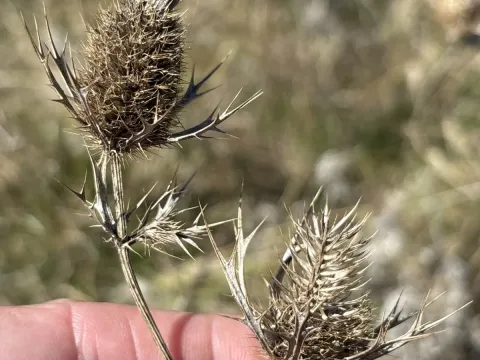
Leavenworth's eryngo
Eryngium leavenworthii
Leavenworth's eryngo (Eryngium leavenworthii) is an annual species belonging to the Apiaceae family. It is typically propagated by seeds, which require stratification to break dormancy and ensure uniform germination across the field.
What the section contains
Leavenworth's eryngo
Sowing should ideally occur in the late autumn for outdoor wintering, or in early spring following a period of cold stratification in a refrigerator. The seeds are small and should be placed at a depth of roughly 0.5 to 1 centimeter.
Spacing is a critical factor for healthy development; plants should be separated by at least 30-40 centimeters to ensure adequate airflow and prevent the competitive pressure of nearby weeds.
Early development of this species is relatively slow, making it susceptible to weed competition. Growers are advised to keep the seedbed clean until the plants establish their deep taproots, which are characteristic of this species.
Germination success is closely linked to soil temperature. A range of +18 to +22 degrees Celsius is optimal, ensuring the emergence of seedlings within approximately 14 to 21 days after the initial sowing.
Native to the prairies of the south-central United States, Leavenworth's eryngo is highly adapted to arid conditions and high levels of solar radiation. It thrives best in full sun, which is essential for developing its intense, characteristic purple-blue pigment.
The plant requires well-drained, sandy, or rocky soil. It is notoriously intolerant of waterlogged soil, which leads to rapid root rot. Agricultural sites with high clay content should be amended with organic or inorganic material to improve drainage.
Regarding soil pH, a neutral or slightly alkaline environment is preferable. The species exhibits strong drought resistance once established, effectively minimizing the need for supplemental irrigation in most climates.
Excessive fertilization is detrimental to the plant's structural integrity. High nitrogen levels can result in weak, floppy stems that are less desirable for both landscape aesthetics and floral harvesting purposes.
Adequate ventilation is necessary for the plant's health. In humid climates, growers must pay close attention to spacing to reduce the risk of fungal infections that can occur in dense, unventilated stands.
As a specialized ornamental crop, the "yield" is measured by the number and quality of floral heads produced. Leavenworth's eryngo is prized for its architectural form and vibrant, metallic blue coloration.
Harvestable product is optimized by selecting sites with maximum light intensity. When cultivated under ideal conditions, a single plant produces multiple branching stems, providing a high density of flower heads per square meter.
Beyond its value as a cut flower, this species serves as a valuable nectar source for bees and various beneficial insects. Integrating this crop into a farm ecosystem can improve overall pollination rates for neighboring plants.
The commercial lifespan of the crop concludes at the end of the first growing season. Consistent harvest of stems can be managed if the plant is pruned correctly, encouraging secondary blooms if the climate remains warm.
For growers focusing on seed production, the yield is determined by the number of mature heads left on the plant to complete their physiological maturity, turning deep brown and brittle.
Fungal pathogens, particularly root rot (Phytophthora spp.), represent the primary threat to the crop. These are almost exclusively associated with improper water management and poor soil drainage.
Aphids can occasionally infest the growing tips during the vegetative stage. While rarely causing total crop failure, they can deform foliage and attract sooty mold, which detracts from the plant’s marketability.
Powdery mildew is a potential risk in areas with high humidity or stagnant air circulation. The white fungal growth on leaves is unsightly and can reduce the overall health and vigor of the plants.
Because the plant contains oils and has a prickly texture, it is generally ignored by most mammalian herbivores. However, cutworms or similar soil-dwelling pests may target seedlings in the early spring.
- Monitor soil moisture levels closely.
- Avoid over-fertilization with nitrogen.
- Remove weeds early in the growth cycle.
The harvest for dried arrangements must occur when the flower heads have fully developed their iconic metallic blue color but before they begin to shed their seeds or degrade in texture.
Stems should be cut in the morning after dew has evaporated to prevent moisture-related issues during the drying process. Hanging the bundles upside down in a dark, airy place is crucial for color retention.
The drying process typically requires 7 to 14 days. Direct exposure to sunlight during this phase must be avoided at all costs, as UV radiation will bleach the blue pigments, rendering the flowers less attractive.
For seed collection, the heads should be allowed to turn dark brown on the plant before being removed. The collected heads should then be placed in breathable containers to continue drying.
Once dried and cleaned, the seeds must be stored in a cool, dark, and dry environment. This preserves their viability, ensuring successful germination for the following year's planting cycle.