
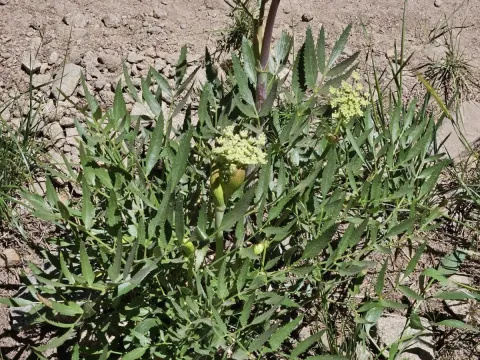
Brewer's angelica
Angelica breweri
Brewer's angelica (Angelica breweri) is a perennial herb belonging to the Apiaceae family, native to the Sierra Nevada mountains in California.
What the section contains
Brewer's angelica
Propagation is primarily done via seeds, which necessitate a cold stratification period to break dormancy and ensure uniform germination in the field.
Sowing should take place in late autumn, allowing the seeds to experience winter temperatures naturally, which is crucial for their physiological development.
If direct seeding in spring, seeds should be sown thinly into well-prepared soil and covered with a very light layer of fine substrate to prevent drying.
The seedling stage is characterized by slow initial growth, requiring meticulous weed control and consistent moisture to allow the plant to establish its taproot.
The plant thrives in cool, montane environments and is highly sensitive to the high temperatures and dry conditions characteristic of lowland summers.
Soil requirements include deep, rich, and well-draining loam that can retain moisture without becoming waterlogged during periods of precipitation.
Full sun is generally acceptable in cooler northern climates, but partial shade is highly recommended in regions with more intense solar radiation.
Maintaining a stable level of soil moisture is the primary challenge in horticultural management of this species, requiring consistent irrigation regimes.
Organic matter enrichment of the soil prior to planting provides the necessary nutrients for long-term development of this hardy perennial herb.
Root rot represents the most significant threat to Brewer's angelica, typically occurring in conditions with poor drainage or over-irrigation.
Pest issues are generally limited to common garden insects such as aphids or leaf miners, which can be managed through natural predators or soap-based sprays.
Preventative cultural practices, such as ensuring adequate spacing between individual plants to promote airflow, significantly reduce the risk of fungal infections.
Care must be taken to remove any plant debris from the plot at the end of the growing season to prevent the overwintering of pathogens.
Monitoring the soil pH is also essential, as imbalances can lead to micronutrient deficiencies that make the plant more susceptible to opportunistic diseases.