
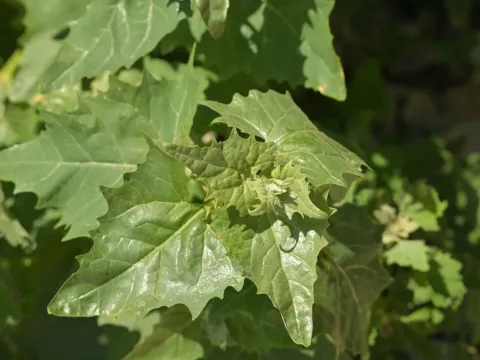
Sagittate saltbush
Atriplex sagittata
Sagittate saltbush (Atriplex sagittata) is an annual herbaceous plant belonging to the Amaranthaceae family. In agricultural practices, this species is increasingly valued as a forage crop due to its high growth energy during the initial stages of development.
What the section contains
Sagittate saltbush
The seeds of Atriplex sagittata exhibit high germination rates under moderate soil temperature conditions. The optimal sowing time is early spring, once the soil has warmed to 8–10 degrees Celsius, allowing the crop to efficiently utilize residual winter moisture.
For high-quality forage or seed production, row sowing with spacing between 30 and 45 centimeters is standard. The sowing depth should be maintained between 1 and 2 centimeters, depending on the soil's mechanical composition and current moisture levels.
The plant demonstrates rapid post-emergence growth, which allows it to cover the soil surface quickly and suppress competitive weed growth. This competitive advantage makes the crop highly suitable for short-cycle crop rotation systems.
After sowing, it is recommended to roll the soil surface to ensure optimal seed-to-soil contact, which promotes uniform germination and consistent crop density across the entire field.
This crop has moderate climatic requirements, displaying significant resilience to drought periods and high summer temperatures. It is well-adapted to the environments of steppe and forest-steppe zones.
Sagittate saltbush prefers fertile, well-aerated soils with a neutral or slightly alkaline pH. It shows remarkable tolerance for saline substrates, making it a viable option for soils where many traditional grain crops might struggle or fail.
The plant is light-loving; therefore, selection of a field site should avoid areas shaded by trees or taller vegetation. Sufficient sunlight is crucial for the accumulation of nutrients in the biomass and overall productivity.
A stable temperature regime is essential for effective growth throughout the vegetative period. Late spring frosts can negatively impact seedling development, meaning sowing schedules must be aligned with reliable local weather forecasts.
Water requirements are highest during the phase of active vegetative biomass accumulation. Although the plant is drought-tolerant, timely rainfall during critical growth stages significantly increases the yield per hectare.
The yield of green biomass from sagittate saltbush depends on soil fertility and the level of agricultural inputs. With proper management, the crop produces significant volumes of succulent biomass rich in protein and essential minerals.
Economic use primarily involves harvesting for silage, haylage, or direct grazing as a source of succulent feed for livestock. Its high nutritional profile makes it a valuable asset for integrated livestock farms.
During intensive production, the focus remains on harvesting the crop before the onset of reproductive development (seed formation). This strategy ensures that nutrient concentrations in stems and leaves are maximized at the time of harvest.
Productivity is monitored through regular assessment of biomass density across different field sections. Under favorable conditions, the yield is highly competitive with other annual forage grasses grown in similar geographic regions.
Maintaining optimal plant density is vital for yield consistency. Both over-crowded and sparsely populated fields can lead to reduced output, making precise control over seeding rates a priority for every agronomist.
Sagittate saltbush is generally resistant to many common diseases, although high humidity and poor air circulation in dense stands may promote powdery mildew or rust infections, which compromise fodder quality.
Insect pests are the primary threat, particularly those that feed on foliage, such as beet leaf beetles or various species of moth caterpillars. Regular field monitoring during the seedling stage is essential to prevent severe damage.
- Use of crop rotation to break pathogen cycles.
- Inter-row cultivation to improve aeration and control pest habitats.
- Systematic crop inspection during the emergence of the first true leaves.
- Judicious use of insecticides only when economic damage thresholds are exceeded.
- Maintaining optimal plant density to improve field ventilation.
Proactive management includes sourcing high-quality, disease-free seed material and, if necessary, seed treatment to reduce the risk of pathogen transmission at the start of the growth cycle.
If major pest outbreaks occur, the agronomist must weigh management options, ensuring that any protective measures taken are compliant with safety regulations regarding the eventual use of the biomass as animal feed.
Harvesting sagittate saltbush for forage should occur before mass flowering, as this period represents the peak of nutritional value before nutrients are diverted to generative processes.
For silage, harvesting is carried out using forage harvesters with chopping mechanisms. Careful adjustment of the cutting height is required to avoid soil contamination, which preserves the quality and hygiene of the final feed product.
When producing hay, equipment that allows for rapid wilting is preferred. Conditioning the stems significantly accelerates the drying process, which is critical for preserving the leaves, as they contain the bulk of the plant’s nutritional value.
For seed production, harvest occurs once the seeds reach physiological maturity. Combine harvesters should be configured for gentle threshing to minimize losses and prevent physical damage to the seed embryos.
After the harvest is complete, rapid processing and storage are necessary to prevent mold development, ensuring that the stored biomass or seeds remain safe and high-quality for future use.