
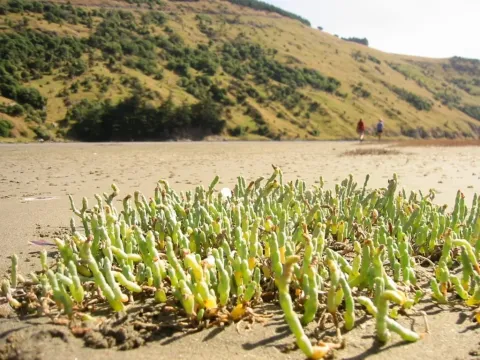
Salicornia
Salicornia
Sowing of Salicornia is typically performed during the spring season when temperatures are consistently warm enough to support germination.
What the section contains

Salicornia
The seeds are exceptionally small, necessitating a very shallow sowing depth, ideally around 0.5 to 1 centimeter, to ensure emergence.
Adequate soil moisture is critical during the initial germination phase; irrigation with brackish or saline water is often beneficial.
Seed density is adjusted according to the soil conditions and the intended use of the crop, with 200,000 to 300,000 plants per hectare being standard.
In large-scale farming, precision seeding equipment is used to distribute the tiny seeds evenly across prepared saline fields.
Salicornia is a member of the Amaranthaceae family and is recognized as a premier halophyte, thriving in high-salinity environments.
The plant requires high solar radiation and thrives in coastal climates, which are natural habitats for this species of vegetation.
Soil salinity is not merely tolerated by Salicornia; it is often required for the plant to achieve optimal growth and biochemical development.
Although it is drought-resistant, consistent irrigation with saline water significantly boosts biomass production in commercial settings.
The ideal pH levels for cultivation are generally neutral to slightly alkaline, consistent with typical coastal or salt marsh conditions.
The yield of Salicornia green mass depends heavily on the salinity levels of the irrigation water and the availability of essential soil nutrients.
Under managed conditions, yields can reach 15 to 25 tons of fresh biomass per hectare, depending on the specific cultivar and harvest cycle.
The seeds are a valuable source of edible and industrial oils, with an oil content that can range between 25 and 30 percent by weight.
Salicornia is increasingly studied as a sustainable feedstock for biodiesel production, as it utilizes land unsuitable for traditional agriculture.
Proper nitrogen management in saline soils is key to maximizing vegetative growth without compromising the plant's natural salt-tolerance mechanisms.
Salicornia possesses an excellent natural resistance to most agricultural pests and diseases due to its unique physiological environment.
Root rot caused by fungal pathogens may occur if fields are flooded with pure, salt-free water for extended periods, destabilizing the plant.
Pest pressure is generally very low; however, localized infestations by specific salt-tolerant insects can occur in intensive monocultures.
Competition from weeds is minimal, as very few plant species can survive the extreme salinity levels that Salicornia prefers.
Physiological stress can manifest if environmental conditions fluctuate rapidly, particularly regarding water salinity and soil drainage.
Harvesting for culinary purposes involves collecting young, tender succulent stems before the plant begins to lignify or harden.
Mechanical harvesting is common in commercial fields, utilizing specialized cutters set to trim the crop at a precise height above ground.
For seed production, the crop is left in the field until it reaches full maturity, signaled by the plants turning a characteristic brownish color.
Post-harvest handling must be efficient to maintain the freshness of the product, especially when supplying the fresh vegetable market.
Drying and cleaning processes are essential for seed crops to ensure high quality and longevity during storage before oil extraction.