
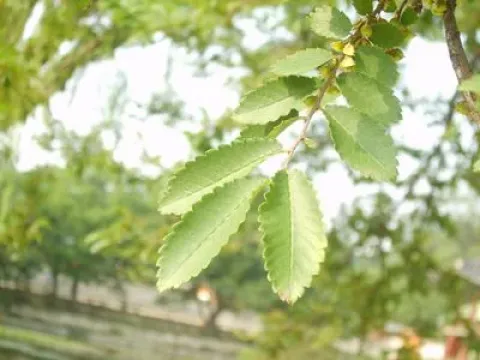
Hemiptelea davidii
Hemiptelea davidii
Hemiptelea davidii, commonly known as the David Hemiptelea, is a deciduous shrub or tree belonging to the Ulmaceae family. It is native to East Asia, primarily occurring in parts of China, Korea, and Mongolia, where it grows in diverse topographical settings.
What the section contains
Hemiptelea davidii
The plant is botanically distinct due to its stiff, thorny branches, which provide structural density. This feature, combined with its ability to withstand pruning, makes it an excellent candidate for the creation of impenetrable natural hedges and security barriers.
Climatically, the species is well-adapted to temperate regions. It displays significant cold hardiness and is capable of thriving in areas with distinct seasonal temperature fluctuations, as well as being highly tolerant of prolonged dry spells.
Regarding soil, this culture is remarkably undemanding. It can establish itself in a variety of substrates, ranging from alluvial soils in river valleys to poor, rocky soils found on hilly terrains, provided that the soil is not permanently waterlogged.
From an agricultural and forestry perspective, it serves as a valuable resource for land reclamation. Its extensive root system contributes to soil stability, making it an effective choice for reinforcing slopes prone to erosion and wind damage.
One of the primary advantages of cultivating Hemiptelea davidii is its natural resistance to many pathogens that devastate the Ulmus genus. It is particularly noted for its high resistance to Dutch elm disease, a major pest for other elm relatives.
While the tree is exceptionally hardy, young saplings may occasionally be targeted by generalist leaf-eating insects. Monitoring is recommended during the first few growing seasons to ensure healthy development.
Potential threats also include competition from invasive weeds during the early establishment phase. Keeping the area surrounding the base of the plant free of aggressive grass species is essential for nutrient access.
Although it is not prone to major systemic infections, fungal leaf spots can occur in environments with extremely poor airflow and high humidity. Proper spacing during planting mitigates this risk significantly.
Good agricultural practice involves regular monitoring for scale insects, which may occasionally infest the bark. If detected, prompt removal or specific horticultural oil treatments are usually sufficient to control the infestation.