
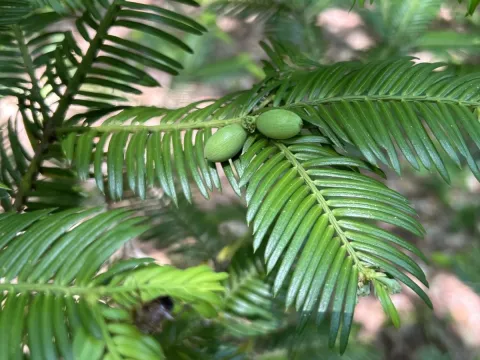
Plum yew
Cephalotaxus
The plum yew belongs to the Cephalotaxaceae family. It is a slow-growing evergreen conifer known for its dense, dark green foliage and long, soft needles that provide a lush appearance in shaded landscape areas.
What the section contains
 Cephalotaxus lanceolata
Cephalotaxus lanceolata
Cephalotaxus lanceolata
 Cephalotaxus mannii
Cephalotaxus mannii
Cephalotaxus mannii
 Chinese plum yew
Cephalotaxus fortunei
Chinese plum yew
Cephalotaxus fortunei
 Chinese plum yew
Cephalotaxus sinensis
Chinese plum yew
Cephalotaxus sinensis
 Griffith's plum yew
Cephalotaxus griffithii
Griffith's plum yew
Cephalotaxus griffithii
 Hainan plum yew
Cephalotaxus hainanensis
Hainan plum yew
Cephalotaxus hainanensis
 Oliver's plum yew
Cephalotaxus oliveri
Oliver's plum yew
Cephalotaxus oliveri
 Plum Yew
Cephalotaxus harringtonia
Plum Yew
Cephalotaxus harringtonia
 Wilson's Plum Yew
Cephalotaxus wilsoniana
Wilson's Plum Yew
Cephalotaxus wilsoniana
Plum yew
Native to East Asia, including regions in China, Japan, and Korea, the plant is naturally adapted to the understory of cool, moist forests. This evolutionary history makes it highly tolerant of shade compared to most other conifers.
The climate requirements involve protection from extreme cold and drying winds. Plum yew thrives in USDA hardiness zones that offer moderate temperatures and reliable moisture, as it does not tolerate severe, long-term desiccation.
Soil conditions must focus on excellent drainage, as the species is sensitive to waterlogged environments. It prefers fertile, slightly acidic, and well-aerated soil compositions, making it ideal for mixed borders and woodland gardens.
Cultivation practices include consistent watering during the establishment phase and regular mulching to keep the root system cool. Once established, the plant shows good resilience, although it benefits from sheltered planting sites.
Primary health threats include root rot diseases caused by soil-borne fungi, typically occurring in poorly drained locations. Proper soil management and avoiding overhead irrigation during humid periods are critical for disease prevention.
Pests like spider mites and scale insects are known to infest the foliage. Monitoring the plant for signs of discolored needles or fine webbing is essential, followed by appropriate treatments with systemic or contact insecticides.
The plant is highly valued for its ornamental versatility, serving as a specimen plant, foundation shrub, or low hedge. It is widely used in landscape design for its ability to maintain color and form throughout the winter.
Propagation is typically achieved through stem cuttings, which should be taken during the late summer season. Using rooting hormones and maintaining consistent high humidity in a propagation chamber increases success rates significantly.
Pruning is usually minimal, focused on removing deadwood or maintaining a specific architectural shape. Because of its slow growth rate, the plant requires infrequent maintenance, making it a sustainable choice for professional landscaping.