
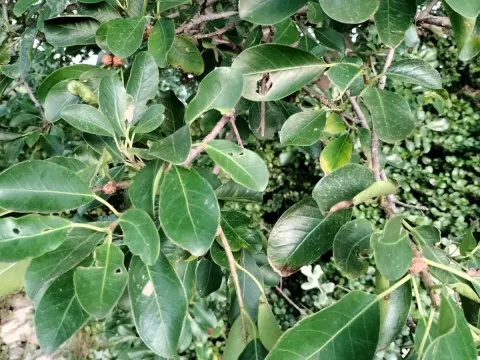
Thonning's fig
Ficus thonningii
Thonning's fig (Ficus thonningii) is a prominent member of the Moraceae family. It is a large, evergreen tree that often begins its life cycle as a hemi-epiphyte, eventually developing a robust root system that anchors it firmly in the soil.
What the section contains
Thonning's fig
Native to tropical Africa, this species thrives in a wide range of habitats, including forests, woodlands, and savannahs. Its distribution makes it an excellent candidate for various agroforestry systems across the continent.
In terms of climate, the tree prefers tropical temperatures and moderate to high humidity. While it is adaptable to different soil types, it performs best in deep, fertile, and well-drained soils where root development is not impeded.
Agricultural practices for this culture emphasize proper pruning to encourage bushy growth. This technique is essential for fodder production, as it stimulates the plant to produce a high volume of nutritious foliage for livestock.
The tree's resilience makes it a valuable asset in land management. Its ability to tolerate various environmental stresses allows farmers to utilize it for erosion control and shade provision in diverse tropical farming environments.
The biomass yield of Ficus thonningii is highly regarded in fodder production. Farmers often rely on its leaves during the dry season, when other pasture sources are depleted and nutritional gaps occur.
Strategic harvesting involves rotating the pruning schedule across the farm. This ensures that the trees recover efficiently while providing a continuous supply of green matter for goats, sheep, and cattle.
Optimal yields are achieved when the tree is provided with adequate nutrients. While it can survive in poor soils, supplemental organic fertilizer significantly boosts leaf production and overall tree vigor.
Beyond livestock feed, the tree provides woody biomass that can be utilized as small-scale timber or fuel, contributing to the overall farm energy budget.
Sustainable harvesting of the tree ensures its longevity. Proper management practices prevent over-harvesting and promote a healthy regrowth cycle that lasts for several decades.
Disease outbreaks in Ficus thonningii are generally rare but can occur in high-density plantations. Leaf spot fungi are the most common issue, often triggered by prolonged damp conditions.
Pest pressure from defoliating caterpillars and borers can impact productivity. Regular monitoring of the foliage and stems allows for early intervention before damage becomes extensive.
Scale insects are another common concern, as they weaken the tree by feeding on the phloem. Biological control methods, such as encouraging local predatory insects, are usually preferred over chemicals.
Root-knot nematodes can present a threat in sandy, nutrient-poor soils. Incorporating high levels of organic matter into the soil helps manage nematode populations and improves root health.
Sanitation is key to managing threats. Removing infected branches and clearing debris from the tree base reduces the risk of spreading pathogens throughout the grove.